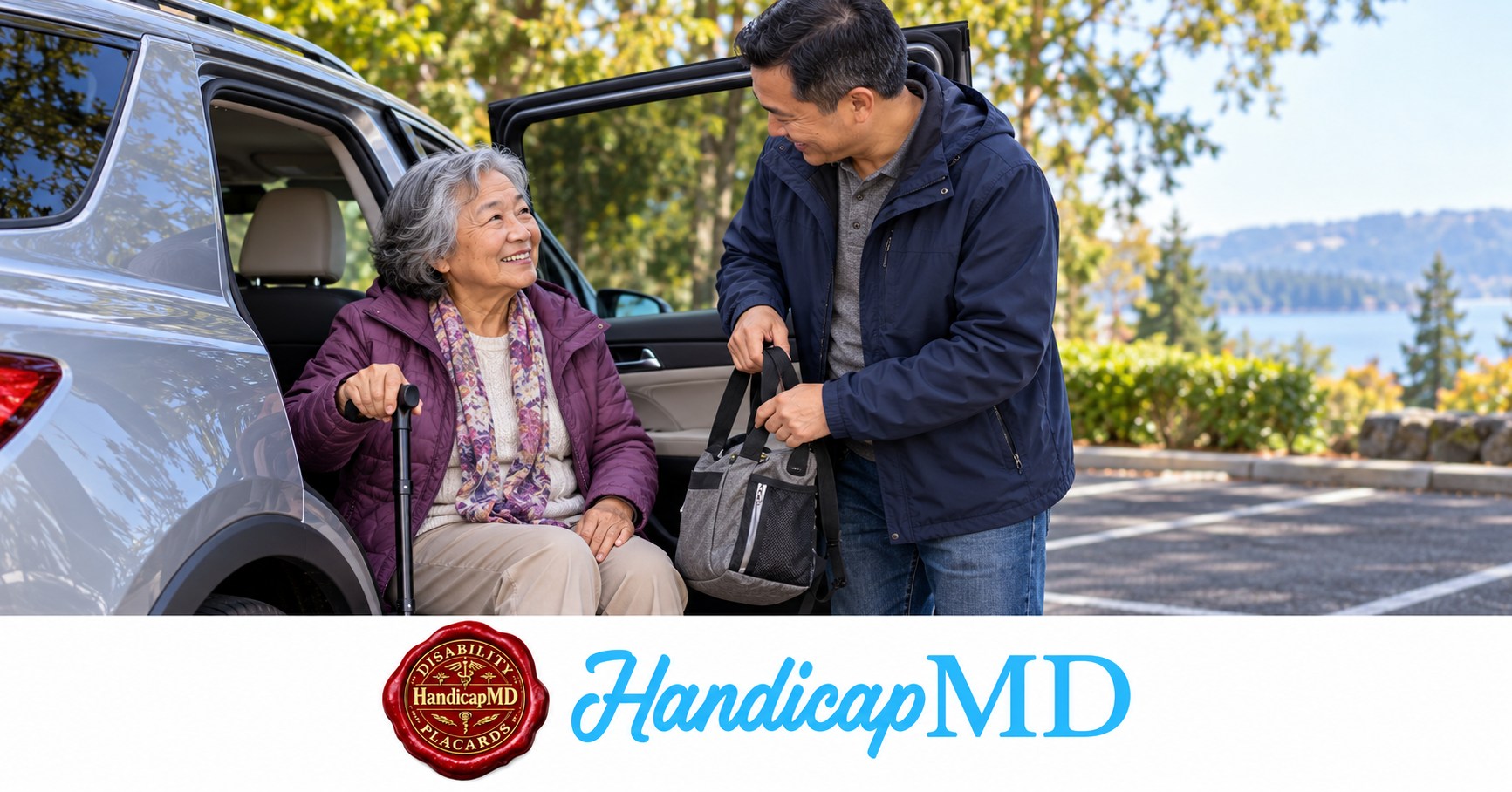
HandicapMD explains non-driver identification, passenger applications, caregiver assistance, representative signatures, and changing rides.
WASHINGTON, DC, UNITED STATES, November 12, 2026 /EINPresswire.com/ — HandicapMD is launching a passenger and caregiver application guide for people researching handicap placards without a driver’s license. The resource explains how a personal disability parking credential can support an eligible passenger and why the applicant’s identity must remain clear when someone else drives. It brings medical certification, non-driver documentation, representative signatures, and the practical handoff between different rides into one organized discussion.
The non-driver handicap placard application guide is intended for adults, families, and caregivers preparing an individual request. Readers can explore HandicapMD for medical evaluation information and review the national handicap parking eligibility guide for state criteria. The guide focuses on the person whose limitation is being assessed, while recognizing that a parent, relative, friend, or paid helper may handle part of the paperwork or journey.
Begin with the passenger’s application
Not driving does not universally prevent a person from obtaining a personal placard. New York’s current application expressly states that parking permit applicants do not need a driver’s license or vehicle ownership. The relevant disability criteria and application requirements still apply. That example clarifies a common misunderstanding without removing another jurisdiction’s identity, residency, or documentation rules.
A caregiver should not enter their own medical information simply because they own the vehicle. The person with the potentially qualifying limitation remains the subject of the assessment. Read the section labels carefully: applicant information, representative information, vehicle details, and medical certification may serve different purposes on a combined form. Completing the appropriate fields is more useful than filling every blank with the driver’s details.
Driving status and disability parking eligibility address different questions. Stopping driving does not automatically establish a qualifying limitation, and continuing to hold a license does not automatically prevent a placard assessment. Explain the actual route from the vehicle to the destination and the relevant functional difficulty. A clinician must evaluate the applicable criteria rather than infer an outcome from who holds the car keys.
Separate personal placards from vehicle plates
A removable personal placard and disability license plates can have different application requirements. The first concerns the eligible person’s authorized transportation; the second also involves vehicle registration and program rules. A passenger who rides in several vehicles should identify the intended credential before collecting registration documents or assuming that a relative’s car must be transferred into the passenger’s name.
New York illustrates this distinction clearly: its instructions permit personal parking applications without vehicle ownership, while disability plate instructions include registration requirements. Other jurisdictions may organize their programs differently. Use the current local instructions instead of treating a plate field on a combined application as proof that every personal placard applicant must own a vehicle.
If the household already has disability plates, ask the issuer about permitted combinations before requesting another credential for different rides. An additional physical document, where allowed, does not create parking privileges for another household member. Request the arrangement the program permits and explain the passenger’s actual transportation pattern rather than assuming every driver should receive an independent copy.
Resolve the identification question accurately
A field labeled for a driver’s license or identification number may allow a non-driver identifier. Read its instructions before assuming it requires a driving credential. If the applicant has neither document, ask the issuing office how to proceed. A standard online screen may not explain every supported circumstance, and entering a caregiver’s number as the applicant’s can create a misleading record.
Local instructions can add important detail. New York’s form says applicants must show a New York driver’s license or non-driver identification card if they have one, while its New York City submission instructions separately request a copy of such identification. These distinctions show why the broad statement that passengers can apply does not settle every documentation question. Contact the office responsible for the applicant’s actual residence.
When identity documents have a changed name or address, ask how the application record should be completed. Submit the requested information through the office’s accepted channel and retain a secure copy when appropriate. A helper’s ability to type or mail documents does not change whose identity the individual program is evaluating. Keep the applicant and helper roles visible throughout the packet.
Plan who may sign and who may assist
Assistance reading a form, entering information, or preparing an envelope differs from authority to sign for another person. Ask the issuing agency about its permitted signature procedure if the applicant cannot use the ordinary process. A close family relationship alone should not be treated as an instruction to sign someone else’s name or complete a representative declaration without the required basis.
For a child, use the program’s parent or guardian instructions. New York’s application provides a signature route for the person with a disability or a parent or guardian and asks for the relationship. Other forms may use different language or supporting requirements. The child remains the person whose qualifying limitation is assessed, rather than the parent receiving a credential for general drop-off convenience.
Adults may want practical help while continuing to direct the application themselves. Agree on whether the helper will read instructions, organize appointments, take notes, or submit documents within the rules. Tell the evaluating practice who is participating. This approach can preserve the applicant’s voice while making a complicated task more manageable, without assuming that assistance with one step confers unrestricted authority over every other step.
Medical assessment still concerns the passenger
A passenger may have limited walking endurance, require walking assistance, use prescribed portable oxygen, or have another relevant limitation under the state’s criteria. Describe ordinary function accurately and identify support actually used. The caregiver can contribute observations, but should distinguish those observations from the applicant’s account and from medical findings only a professional can establish.
For example, a companion may observe that the passenger needs a rest before an entrance or assistance after leaving the vehicle. Explain the route and circumstances without turning an estimate into a precise measurement. If the passenger avoids certain journeys, mention the planning choice and the reason. An absence of recent long outings does not independently describe how the person would manage them.
Give the clinician the current form and ask which relevant records would help. The accepted professional category, scope of certification, and adequacy of the assessment still matter. A passenger application is not a reduced medical standard. Nor should an applicant perform an unsafe demonstration or withhold usual support to make a limitation visible for a camera or office visit.
Prepare the complete packet together
Before filing, check that the same applicant appears in the identifying and medical sections. A helper managing several family forms can inadvertently combine pages from different packets. Review the credential requested, address, dates, signatures, and required attachments as one complete application. Leave medical conclusions and corrections to the authorized clinician rather than rewriting the certification to match a preferred category.
If an online process does not fit a non-driver’s circumstances, contact the agency about its supported alternative. Do not invent vehicle ownership, identification, or a representative relationship to pass a required screen. The appropriate answer may involve an assisted or paper route, but the issuing office should identify the procedure for that case. Ask before sending an incomplete or inaccurate request.
Keep a record of submission and any reference number. Medical certification, a completed download, or an application receipt does not issue a placard. The government program reviews and supplies the credential through its process. If the packet is returned, read whether the problem concerns identity, signatures, a missing attachment, or medical eligibility, since each issue calls for a different response.
Make the credential available for changing rides
An individual passenger may travel with different relatives during the same week or have a different driver for the return trip. Agree on where the original placard stays and how it moves with the holder under the program’s rules. Leaving it permanently in one vehicle can make it unavailable for another authorized journey, especially when a borrowed or rental car is involved.
Consider a hypothetical appointment with a neighbor providing the outbound ride and an adult child providing the return. Plan the handoff before departure so the second driver does not depend on a photograph or photocopy as a display substitute. This is a logistical example, not a promise about a particular jurisdiction’s use rules. Confirm those rules with the issuing office.
The driver does not acquire unrestricted use by transporting the holder once. New York’s instructions, for example, limit reserved-space use to when the person with the disability rides in or drives the vehicle. A caregiver’s independent errands after the passenger is home are a different trip. Explain the applicable holder and trip rules to every regular driver so storage arrangements do not encourage misuse.
Coordinate the arrival, not only the parking
A personal placard does not guarantee a suitable taxi, a vehicle that accommodates equipment, or enrollment in a transportation service. Confirm the ride’s practical requirements with the provider. For a destination, ask about the useful entrance, appropriate passenger loading location, available seating, and the return pickup. A reserved parking space is only one part of getting the passenger to the intended activity.
For a school, clinic, or residential facility, identify who controls any restricted lane or pickup procedure. The credential does not automatically authorize entry into every controlled area or stopping in a prohibited location. Explain the passenger’s access need and ask the responsible organization to clarify an appropriate arrangement. Keep the outbound and return plan consistent with that destination’s actual operation.
Drivers need clear operational instructions about credential display, payment, local restrictions, and where to return the original. They do not ordinarily need an applicant’s complete clinical file to follow those instructions. A short trip note can address the entrance and handoff while leaving private treatment information with the people responsible for care. Ask the holder what practical information they want shared.
Keep the arrangement current
Record the credential’s expiration, the responsible issuing office, and the applicant’s current contact details. A change of helper should not make renewal information disappear. Identify whether renewal, replacement, or an address update is the next task before assuming another initial medical evaluation is necessary. Follow the actual program’s requirements for that transaction and keep the holder involved in decisions whenever possible.
If a placard is lost in another vehicle, contact the issuer about replacement and the status of the missing credential. A photograph can help locate identifying information but should not be treated as authority to manufacture another display copy. Review the handoff plan afterward so the replacement remains available for the holder’s trips without creating extra unapproved documents.
About the passenger guide
HandicapMD’s guide supports a clear individual application and a practical transportation plan for non-drivers. It connects accurate identity and representative information with medical assessment, government submission, and authorized passenger use. Readers can begin by identifying the eligible person, finding the current form, and assigning helpful tasks without confusing the driver’s role with the applicant’s qualification.
An effective first conversation can be simple: explain who needs assessment, who can help with the request, and which document or instruction remains unclear. Ask the clinician about the medical issue and the issuer about identity or submission questions. That division can reduce avoidable repetition while keeping responsibility clear. The outcome remains individual, and the credential, if issued, supports the holder rather than becoming a general convenience for the household.
About HandicapMD
HandicapMD provides online medical evaluations related to disability parking certification. When supported by the clinical assessment and applicable requirements, a licensed clinician completes the medical portion of the relevant application. The company’s educational resources explain state processes and help residents prepare questions. Government agencies retain responsibility for reviewing applications and issuing parking credentials.
https://www.handicapmd.com/
Crystal Dennon
HandicapMD
help@handicapmd.com
Surprising Facts About Handicap Placards – Not Just for People Who Use Wheelchairs
Legal Disclaimer:
EIN Presswire provides this news content “as is” without warranty of any kind. We do not accept any responsibility or liability
for the accuracy, content, images, videos, licenses, completeness, legality, or reliability of the information contained in this
article. If you have any complaints or copyright issues related to this article, kindly contact the author above.

Media gallery