NANTONG, CHINA, July 9, 2026 /EINPresswire.com/ — “Consumers are no longer just looking for sweets; they are looking for an interactive sensory experience that feels premium yet accessible. This is exactly what aligns with current supermarket demographics.”
This enthusiastic reception highlights the market dominance of the Leading Fruit Jelly Factory, LITAFOOD, an industry pioneer that has successfully transformed traditional fruit jelly from a nostalgic childhood confection into a high-performance, trend-setting product category. The Canton Fair provides the ultimate authoritative backdrop for this market validation, where real-time feedback from global distributors confirms that high-quality, structurally innovative gelatin and carrageenan-based products are capturing a disproportionate share of modern retail growth. Fruit jelly, when manufactured with precision, offers an optimized balance of shelf stability, elasticity, and clean flavor release, making it a highly lucrative segment for global brands aiming to capture diverse age demographics.
Spotlight 1: Structural Innovation and the Mechanics of the Fruit-Shape Case Study
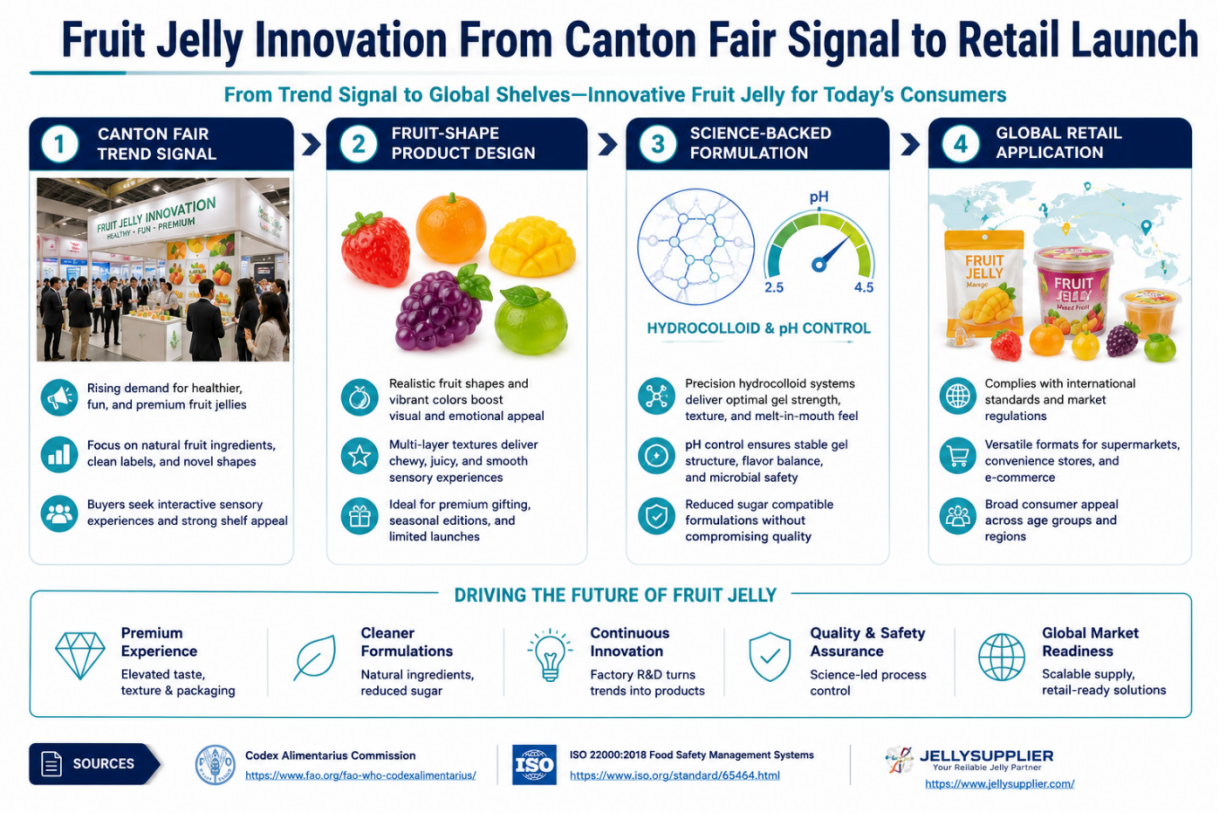
To understand why international buyers are prioritizing these products, one must examine the specific engineering behind modern confectionery design. A prime example of this technical excellence can be observed in the popular Fruit Shape Jelly Bag, a product case study that demonstrates how form and function interact to drive retail velocity. Unlike standard, flat-molded jellies, these specialized items utilize advanced three-dimensional injection molding techniques to replicate the precise contours, textures, and visual appeal of real fruits such as strawberries, grapes, and mangoes.
From a technical perspective, achieving a realistic fruit shape requires meticulous control over the gelation temperature and viscosity of the raw formula. The production line utilizes automated high-precision volumetric depositors that inject the liquid jelly mass into custom-engineered, multi-part food-grade silicone and aluminum molds at a tightly regulated temperature range of 85 to 90 degrees Celsius. This specific thermal threshold ensures that the liquid fills every intricate micro-detail of the mold without creating air pockets or structural weaknesses. The parameters of the product are optimized for global logistics: each individual jelly piece is systematically calibrated to a uniform weight, typically ranging between 15 to 25 grams, ensuring consistent caloric delivery and structural integrity. The moisture content is carefully maintained between 18% and 22%, which achieves the precise chewiness index required by international quality standards while preventing the migration of water to the inner walls of the packaging.
Spotlight 2: Advanced Formulations and the Role of Precision Ingredients
Behind the sensory appeal of the fruit-shaped confectionery lies a sophisticated framework of ingredient science. As global consumer preferences lean increasingly toward clean-label attributes, texturizing stability, and consistent mouthfeel, the manufacturing process must adapt through rigorous formulation control. The production methodology championed by LITAFOOD integrates over twenty years of industrial expertise to balance elasticity, tensile strength, and flavor dispersion.
The core matrix of the jelly relies on a synergistic blend of hydrocolloids, primarily high-grade carrageenan extracted from natural seaweed, combined with refined konjac flour. Carrageenan provides a firm, clean-snapping texture that releases flavor immediately upon mastication, while konjac flour introduces the necessary elasticity and resilience to prevent the product from becoming overly brittle or melting under fluctuating tropical transit temperatures. The precise ratio of these hydrocolloids is governed by the pH level of the fruit juice concentrate added to the mix. Because citric acid and malic acid are required to give the jelly its authentic, tart fruit flavor profile, the production team monitors the pH level constantly, keeping it within a strict 3.8 to 4.2 range. If the mixture is too acidic, the hydrocolloid chain breaks down during the heating phase, resulting in a weak gel; if it is too alkaline, the texture becomes rubbery and unpalatable. By deploying automated digital pH titrators and continuous-induction blending tanks, the factory ensures that every batch maintains an identical molecular structure, guaranteeing a uniform consumer experience whether the product is opened in New York, London, or Tokyo.
Spotlight 3: Commercial Versatility and Global Retail Application Scenarios
In the competitive landscape of international retail, a product’s success is determined not only by its laboratory specifications but also by its adaptability across diverse commercial environments. The modern fruit jelly portfolio is specifically engineered to meet the stringent operational demands of multi-tier global supply chains, satisfying the procurement criteria of both discount hypermarkets and premium boutique distributors.
One of the most significant commercial advantages of these advanced fruit jellies is their exceptional shelf stability under varied environmental conditions. Utilizing a multi-layer co-extruded barrier film for individual packaging, the individual jelly units are hermetically sealed in a nitrogen-purged environment. This process effectively reduces residual oxygen levels to below 0.5%, thereby preventing the oxidation of natural fruit pigments and preserving the vivid, transparent colors of the jelly without requiring excessive artificial preservatives. Consequently, the product achieves a robust shelf life of 12 to 18 months at room temperature, eliminating the need for expensive cold-chain logistics and reducing spoilage rates for retailers. This makes the product highly suitable for wide-scale distribution across multiple retail formats:
Mass Hypermarkets and Club Stores: High-volume, family-sized transparent bags provide maximum visual impact on low-shelf pallets, driving impulsive purchasing behavior among parents and children.
Convenience Retail and Impulse Zones: Single-serve, grab-and-go configurations optimized for checkout counters, where the interactive, squeeze-and-eat nature of the packaging serves as a key differentiator from traditional candy bars.
Seasonal Gift Marketing: The authentic fruit appearance enables smooth integration into holiday gift baskets, spring festival promotions, and themed confectionery assortments, allowing retailers to command higher margins.
Driving the Future of Global Confectionery
The insights gathered from the Canton Fair confirm that the future of the global confectionery market belongs to manufacturers who can successfully merge technical innovation with practical commercial application. By focusing on structural realism, ingredient precision, and flexible institutional customization, the modern fruit jelly factory has transitioned from a basic regional supplier into a core architecture provider for global retail snack brands. As consumer trends continue to evolve toward interactive, clean, and visually engaging food options, the dedication to continuous research, rigorous quality control, and advanced hydrocolloid engineering ensures that these innovative confections will continue to dictate trends on the global stage.
For more information regarding product specifications, private label customization capabilities, or to schedule a consultation with the procurement team, please visit the official enterprise platform at https://www.jellysupplier.com/
Nantong Litai Jianlong Food Co., Ltd.
Nantong Litai Jianlong Food Co., Ltd.
email us here
Legal Disclaimer:
EIN Presswire provides this news content “as is” without warranty of any kind. We do not accept any responsibility or liability
for the accuracy, content, images, videos, licenses, completeness, legality, or reliability of the information contained in this
article. If you have any complaints or copyright issues related to this article, kindly contact the author above.

Media gallery