
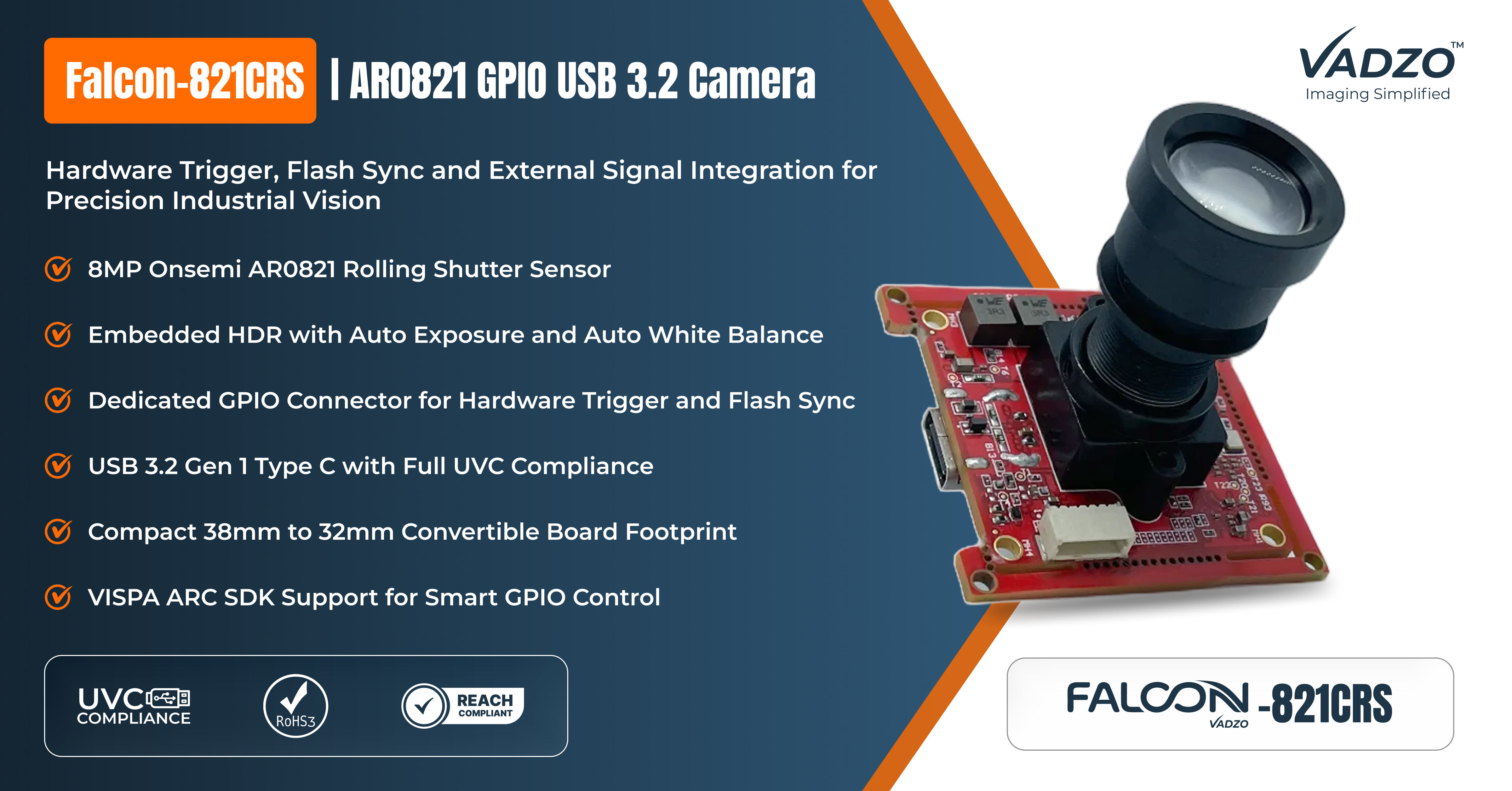
An 8MP AR0821 GPIO USB Camera built on the Onsemi AR0821 image sensor, delivering hardware trigger and flash sync support alongside external signal integration for PCB and semiconductor inspection. The camera connects over USB 3.2 Gen 1 UVC with true plug and play operation, backed by full VISPA ARC SDK support.
FORT WORTH, TX / ACCESS Newswire / July 23, 2026 / Vadzo Imaging today publishes an engineering explainer on the GPIO design inside the Falcon-821CRS, an 8MP 4K HDR USB Camera built for industrial vision workflows where the sensor, the strobe, and the automation controller must fire in exact sequence. Built around the Onsemi AR0821 sensor and functioning as a complete Onsemi AR0821 USB Camera platform and an 8MP USB Camera at its core, the module gives system integrators a direct path to hardware trigger, flash sync and external signal integration without a board redesign and without custom firmware work. For OEM teams building PCB inspection stations, semiconductor inspection cells, or pick and place vision loops, GPIO access of this kind is often the single feature that decides whether a camera fits the production line or gets replaced within the first year of deployment.
The AR0821 sensor brings a 1/1.8 inch CMOS format with 2.1 micron DR Pix pixel technology and rolling shutter readout delivering a maximum resolution of 8MP at 3848 by 2168, positioning the Falcon-821CRS as an 8MP 4K USB Camera built for demanding embedded vision workloads. Paired with a high-performance ISP, the Falcon-821CRS supports embedded HDR processing along with auto white balance and auto exposure control across 4K, 1080p, and 720p video streaming modes. The camera connects over USB 3.2 Gen 1 Type-C with full UVC compliance and backward compatibility to USB 2.0, letting engineers move between prototype and production hosts without changing the interface layer. At a board footprint of 38mm x 38mm convertible to 32mm by 32mm and a weight of 13 grams without lens, the Falcon-821CRS fits directly into compact inspection heads, kiosk enclosures and mobile vision platforms.
Engineering the GPIO Interface for Deterministic Vision Timing
Machine vision systems built around free-running capture lose synchronization the moment illumination timing or a mechanical event drifts away from the frame clock. A hardware trigger USB camera solves this at the electrical level rather than in software, where scheduling delay and driver overhead are difficult to control precisely. The Falcon-821CRS includes a GPIO connector as a standard hardware feature, giving developers a direct electrical path to start capture from an external signal such as a proximity sensor, an encoder pulse, or a PLC output. This GPIO trigger camera architecture also supports strobe sync and functions as a flash sync USB camera, so the illumination source fires in the same instant as the exposure window rather than a few milliseconds before or after it. For conveyor belt vision camera stations and pick and place camera setups where parts move continuously through the field of view, this external trigger camera control is what keeps captured frames sharp instead of motion blurred. Because the GPIO connector sits on the AR0821 GPIO camera hardware itself rather than behind a software abstraction layer, integration teams get consistent trigger behavior across Windows, Linux, and Android hosts without rewriting synchronization logic for each platform. Engineers reviewing the complete GPIO specification alongside pricing tiers can consult the AR0821 4K HDR USB camera product page.
Onsemi AR0821 Sensor Foundation for 4K HDR Imaging
At the center of the Falcon-821CRS is the Onsemi AR0821 image sensor, a 1/1.7 inch BSI CMOS device using 2.1 micron DR Pix pixel technology that gives this AR0821 4K image sensor strong low-light response alongside dynamic range performance. The sensor delivers a maximum still resolution of 8MP at (3848 x 2168) with rolling shutter readout and streams 4K, 1080p, and 720p video through the onboard ISP. For applications that depend on accurate color reproduction, such as PCB inspection, retail analytics and identity capture, the AR0821 color USB camera configuration, an 8MP Color USB Camera built for accurate reproduction, adds auto white balance and auto exposure processing so captured frames stay consistent across changing ambient light without manual recalibration between shifts. Combined with the GPIO connector, this AR0821 HDR camera platform, functioning as an 8MP HDR USB Camera, gives inspection engineers a sensor that can be triggered precisely and still deliver usable dynamic range in cells lit by mixed fixture types, the kind of lighting inconsistency that causes false rejects on camera products without embedded HDR support. Full specifications for the AR0821 4K color USB camera configuration, including sensor format and pixel pitch, are documented on the AR0821 4K HDR USB 3.2 camera order page.
Within the Falcon series, the AR0821 platform spans an AR0821 4K rolling shutter camera configuration, an AR0821 rolling shutter USB camera build, and an AR0821 HDR rolling shutter camera variant, alongside the AR0821 4K color USB camera and AR0821 HDR color USB camera options used in the Falcon-821CRS itself. At the 8MP tier, this same architecture is available as an 8MP Rolling Shutter Camera, an 8MP 4K Rolling Shutter Camera, an 8MP Rolling Shutter USB Camera and an 8MP 4K Color USB Camera, giving OEM teams a single sensor family to standardize around regardless of resolution tier. This gives OEM teams a consistent sensor platform to standardize around across projects with different resolution, HDR, and color requirements. As a 4K HDR industrial camera built on the Onsemi AR0821 image sensor, this platform works equally as a precision embedded vision camera for compact deployments and as a hardware-synchronized camera and trigger input camera for line integrated inspection cells that require deterministic capture timing.
Plug and Play USB 3.2 Gen 1 UVC Integration
OEM programs lose schedule time to camera driver development more often than to any single hardware issue. The Falcon-821CRS avoids that cost entirely by shipping as a fully UVC-compliant USB 3.2 camera, meaning Windows, Linux, and Android hosts recognize it as a standard video device without a proprietary driver stack. Backward compatibility to USB 2.0 means the same camera drops into legacy host hardware where a full USB 3.2 controller is not available, a common constraint on older industrial PCs and embedded carrier boards. Teams building on Linux can reference Vadzo’s guide on streaming a UVC USB camera on Ubuntu with OpenCV for driver-free capture pipelines. Developers deploying on edge AI compute platforms can also review the walkthrough on streaming USB camera products on NVIDIA Jetson AGX Orin using Isaac ROS and the guide for running a USB camera on Raspberry Pi 5, both of which apply directly to the Falcon-821CRS given its shared UVC-compliant architecture across the AR0821 USB 3.2 camera lineup.
Compact Form Factor for Embedded and Automation Deployments
At 38mm x 38mm convertible to 32mm by 32mm and weighing 13 grams without lens, the Falcon-821CRS is built to sit inside inspection heads, kiosk housings and mobile robotics chassis without a mechanical redesign around it. The board uses an S-mount M12 standard lens holder with a default 74-degree DFOV, and the GPIO connector along with the USB 3.2 Type-C interface routes to the edge of the board for straightforward harness routing in tight enclosures. This footprint flexibility supports both industrial inspection camera deployments where the module sits fixed inside a machine frame and mobile deployments such as UAV-based inspection or AGV navigation where every gram and every cubic millimeter of clearance matters. Operating from -30⁰C to 85⁰C, the camera holds calibration through the same thermal swings that inspection lines and outdoor kiosk deployments experience across a full production shift. USB-powered operation removes the need for a separate power supply line, which simplifies wiring in enclosures where space is already committed to lens optics, illumination drivers, and the GPIO harness itself. Teams evaluating board space against optical requirements can review the full 4K HDR USB camera portfolio for comparable form factor options across the AR0821 and related sensor lines. Vadzo’s overview on industrial USB camera design considerations covers additional guidance on board footprint and lens selection for embedded deployments.
VISPA ARC SDK for GPIO and Camera Control
The Falcon-821CRS is supported by the Vadzo VISPA ARC SDK, which exposes Smart GPIO control alongside region of interest configuration, still capture, image flip, and secure firmware update management. APIs are available for Windows and Android with Linux support for the underlying UVC control set, giving embedded vision camera developers a consistent programming surface regardless of host platform. For trigger-heavy deployments, the SDK’s GPIO handling is what turns a hardware trigger USB camera into a fully programmable synchronized vision camera, letting integrators map external trigger input, flash sync output, and status signaling to the same connector without external timing hardware. Vadzo’s engineering team recommends validating GPIO behavior early in the design cycle, since trigger polarity and signal timing vary across PLC vendors and sensor types, and a mismatch discovered late in a program typically costs more schedule time than the initial camera selection itself. Because the SDK exposes GPIO configuration as a documented API rather than a fixed factory setting, integration teams can adjust trigger edge, debounce, and output pulse width in firmware without requesting a custom build from Vadzo, which shortens the iteration loop during bring-up. Background on HDR configuration through the same SDK is available in Vadzo’s post on unlocking the potential of HDR USB camera products, and full SDK documentation is accessible through the Vadzo online store alongside the camera datasheet and CAD files.
|
Specification |
Detail |
|
Sensor |
Onsemi AR0821, 1/1.8″ BSI CMOS |
|
Pixel Size |
2.1 µm x 2.1 µm |
|
Max Resolution |
8MP – 3848(H) x 2168(V) |
|
Shutter |
Rolling Shutter |
|
Chroma |
Color |
|
Optics |
S Mount (M12 Standard) |
|
Lens FOV |
74 DFOV |
|
Interface |
USB 3.2 Gen1 Type C Interface Backward Compatible to USB 2.0 |
|
GPIO Connector |
Yes Available* |
|
Operating Temperature |
-30⁰C to 85⁰C |
|
Dimension |
38mm (L) x 38mm (B) convertible to 32mm (L) x 32mm (B) |
|
OS Supported |
Windows, Linux, Android (Need additional SDK) |
|
Conformity |
UVC Compliant, RoHS 3, REACH |
“A GPIO connector sounds like a small line item on a datasheet until a customer needs a hardware trigger camera and a flash sync camera working together on the same line. When we design a GPIO USB camera into the Falcon series, we are thinking about the PLC engineer routing a trigger line and the vision engineer who needs the strobe to fire in the exact same microsecond as the exposure window. That is the problem the Falcon-821CRS was built to solve for OEM teams working on inspection and automation lines.” – Alwin Vincent, Product Manager, Vadzo Imaging.
Target Applications for the AR0821 GPIO USB Camera
Across every deployment below, the deciding factor for whether a camera survives past the pilot stage is rarely resolution alone. It is whether the camera can be triggered predictably from an external event and whether the resulting frame holds detail under the lighting conditions actually present on the line rather than the lighting conditions present in a lab demo. The Falcon-821CRS is positioned specifically for this gap between demo-grade imaging and production-grade determinism, combining GPIO-based trigger and flash sync with the AR0821 sensor’s embedded HDR range.
PCB and Semiconductor Inspection: Automated optical inspection lines depend on exact synchronization between part presentation, illumination, and image capture, because a strobe fired even a few microseconds off center produces motion blur or inconsistent exposure across boards moving at line speed. The Falcon-821CRS in a PCB inspection camera configuration uses its GPIO connector to accept an external trigger signal directly from the conveyor encoder or the placement fixture, starting exposure only when the board is correctly positioned. Combined with embedded HDR support, this AR0821 semiconductor inspection camera setup captures consistent detail across reflective solder joints, matte substrate surfaces and fine-pitch component markings within a single frame, reducing the need for multiple exposure passes. For laser profiling camera and metrology vision camera integrations running alongside AOI stations, the same GPIO trigger signal can be shared across multiple Falcon-821CRS units for synchronized capture, a common requirement in high-speed vision camera cells inspecting boards from more than one angle.
Pick and Place and Conveyor Vision: Pick and place camera systems verify component orientation and placement accuracy at cycle times measured in fractions of a second, leaving no margin for software-triggered capture delay. The Falcon-821CRS in a conveyor belt vision camera configuration uses its hardware GPIO trigger to fire capture directly in response to the pick head cycle or the conveyor encoder pulse, keeping frame timing locked to the mechanical process rather than to USB polling intervals. Strobe illumination camera setups paired with this trigger path let integrators use short-duration, high-intensity flash exposure to freeze fast-moving components without motion blur, a common requirement in automation and robotics deployments running at industrial line speeds. The rolling shutter AR0821 sensor combined with GPIO-based flash sync gives these lines a repeatable capture window across every cycle rather than an approximate one.
Robotics and Automation: AGV and robotic arm navigation systems depend on consistent frame timing relative to motion control loops. The Falcon-821CRS integrates directly into these architectures through GPIO-based external trigger synchronization, letting the vision system capture frames in step with encoder feedback or motion controller output rather than on an independent clock. Embedded HDR support keeps navigation markers and object edges visible across warehouse environments where lighting shifts between loading dock daylight and interior fixture lighting. Teams building automation and robotics platforms that require synchronized vision camera behavior across multiple units can use the GPIO connector’s master and follower trigger configuration so several camera products on the same line expose at the same instant.
Smart City and Kiosk Deployments: Kiosk and interactive terminal deployments benefit from external signal camera integration less for image capture timing and more for coordinating capture with door sensors, card readers, or button press events. The Falcon-821CRS fits directly into kiosk and digital signage hardware given its compact 32mm by 32mm board option and USB-powered operation with no external power supply requirement. In smart city solutions deployments such as parking access points and public terminal identity capture, the GPIO trigger input lets the camera stay in a low activity state until an external event, such as a vehicle sensor or a proximity trigger, initiates capture, reducing unnecessary frame processing on constrained edge compute hardware.
Security and Surveillance: Surveillance deployments that rely on motion sensors, door contacts, or perimeter break beams benefit from a GPIO connector that can start recording or trigger an alert frame the instant an external sensor fires, rather than depending on continuous stream analysis alone. The Falcon-821CRS brings this external trigger behavior into security and surveillance deployments alongside embedded HDR performance that holds detail through backlit entrances and mixed indoor-outdoor lighting transitions common at dawn and dusk. Flash sync support additionally allows the camera to coordinate with IR or white light illumination for low-light identity capture without relying on long exposure times that introduce motion blur on moving subjects.
Telematics and Fleet Management: Fleet telematics platforms increasingly combine vision capture with vehicle bus events such as door open signals, ignition state or braking events. The Falcon-821CRS supports this through its GPIO connector accepting external trigger input tied directly to vehicle signals, enabling event-based capture rather than continuous recording that would otherwise consume onboard storage and bandwidth. Within telematics and fleet management deployments, this reduces the volume of footage that needs to be reviewed or transmitted while ensuring the frames that matter, such as a hard braking event or a door open outside a geofenced area, are captured with the camera’s full 8MP HDR imaging.
Medical Device and Patient Care: Medical and diagnostic device integrations, including pathology imaging devices, require capture that is synchronized precisely with mechanical stage movement or illumination changes to avoid blur or inconsistent exposure across sample slides. The Falcon-821CRS supports this class of medical device and patient care deployment through GPIO-based external trigger control paired with the AR0821 sensor’s embedded HDR capability, which helps maintain consistent detail across translucent or reflective sample surfaces without operator-side lighting adjustments between samples. The same trigger and HDR combination extends to retail analytics and automation deployments that require repeatable capture timing across variable store lighting.
Frequently Asked Questions
Q: What is a GPIO USB camera and how does hardware trigger work?
A: A GPIO USB camera exposes a set of general-purpose input and output pins directly on the camera board, letting external hardware such as a PLC, an encoder, or a proximity sensor start image capture without relying on a software command sent over the USB bus. This matters because software-triggered capture introduces variable latency from operating system scheduling and driver overhead, while a hardware trigger fires at the electrical signal level with consistent timing every cycle. The Falcon-821CRS implements this through a dedicated GPIO connector alongside the Onsemi AR0821 sensor, giving OEM teams building automated optical inspection camera and pick and place camera systems a trigger path that stays consistent across production volume rather than degrading as system load increases.
Q: How does flash sync work on an industrial USB 3.2 camera?
A: Flash sync coordinates the exact moment a strobe or LED illumination source fires with the exposure window of the image sensor, ensuring the part being inspected is lit only while the shutter is open rather than before or after it. On rolling shutter sensors like the AR0821 in the Falcon-821CRS, this synchronization is handled through the GPIO connector, which can output a signal timed to the exposure start so external strobe illumination camera hardware fires in step with capture. This approach reduces wasted light energy, extends strobe lifespan, and produces consistent exposure across every frame in a production run, which is critical for automated optical inspection and metrology vision camera applications that depend on repeatable image quality.
Q: Which USB 3.2 camera supports an external trigger for automated optical inspection?
A: For automated optical inspection lines that need dependable external trigger support, the Vadzo Falcon-821CRS is built specifically around this requirement. As an 8MP 4K HDR USB Camera, it combines the Onsemi AR0821 sensor’s 8MP resolution and embedded HDR performance with a hardware GPIO connector, USB 3.2 Gen 1 Type C connectivity, and full UVC compliance, so the same camera that accepts a hardware trigger signal also integrates without custom driver development. Engineering teams evaluating options for PCB inspection camera or semiconductor inspection camera lines can review full specifications, pricing tiers, and the downloadable datasheet on the Falcon-821CRS AR0821 GPIO USB camera page.
Q: Can multiple GPIO camera products be synchronized for a multi-camera vision setup?
A: Yes. The GPIO connector on the Falcon-821CRS supports shared trigger signaling, allowing several units to expose at the same instant when wired to a common trigger source such as a PLC output or an encoder pulse. This is a common requirement in synchronized vision camera deployments inspecting a part from multiple angles simultaneously, such as multi-side PCB inspection or reconstruction setups built from several AR0821 4K HDR camera modules. Because every Falcon-821CRS unit shares the same UVC-compliant USB 3.2 Gen 1 interface, integrators can scale from a single camera evaluation setup to a multi-camera production cell without changing host software architecture.
Q: What should engineers look for in an industrial USB camera for PCB inspection?
A: Engineers selecting a camera for PCB inspection or semiconductor inspection camera lines should prioritize hardware trigger support, embedded HDR performance, and a board footprint that fits existing fixture designs, since these three factors most directly affect defect detection accuracy and line throughput. The Vadzo Falcon-821CRS addresses all three through its GPIO connector, its Onsemi AR0821 sensor with HDR-capable ISP processing, and a board footprint of 38mm x 38mm convertible to 32mm x 32mm. Full technical documentation including the camera datasheet and CAD files for fixture design is available through the AR0821 4K HDR USB 3.2 camera product page along with SDK access for GPIO and trigger configuration.
Availability
The Falcon-821CRS Onsemi AR0821 GPIO USB 3.2 Gen 1 UVC camera is available for evaluation and pre-production sampling, with production quantities available for OEM deployment starting at 50-unit pricing tiers. Evaluation units ship with a default 74-degree DFOV M12 lens and a USB 3.2 certified cable, with enclosure and lens options configurable at order. Engineering teams can access the full technical datasheet, CAD files, and VISPA ARC SDK documentation through the Falcon-821CRS product ordering page, or browse the complete UVC USB 3.2 camera portfolio for related sensor options. Customization services including board redesign, firmware modification, and enclosure design are available directly through Vadzo’s engineering team for volume programs.
About Vadzo Imaging
Vadzo Imaging develops embedded and machine vision camera products for OEMs and system integrators building production-ready vision systems across industrial automation, robotics, healthcare and smart infrastructure. The company’s imaging platforms span USB, MIPI, GigE, WiFi and SerDes interfaces covering embedded deployment architectures from compact edge devices to distributed networked systems. Beyond hardware, Vadzo provides sensor integration, ISP tuning, firmware development and SDK frameworks, giving engineering teams a single partner from initial evaluation through production lifecycle management.
Media Contact
Alwin Vincent
Vadzo Imaging
Email: alwin@vadzoimaging.com
LinkedIn: Vadzo Imaging
YouTube: Vadzo Imaging
X: Vadzo Imaging
SOURCE: Vadzo Imaging
View the original press release on ACCESS Newswire


