After Sacrificing Summer, Financial Threats Continue for Consumers in Debt
PR Newswire
NEW YORK, Aug. 21, 2026
Households already managing debt are confronting higher back-to-school costs, hurricane season financial exposure, essential pet care expenses
NEW YORK, Aug. 21, 2026 /PRNewswire/ — National Debt Relief, the industry leader in debt settlement and provider of the top-rated debt relief solution in the U.S.*, today released findings from its latest client surveys showing that, after pulling back on summer spending, Americans already carrying unsecured debt are heading into fall facing financial pressure from rising back-to-school costs, natural disasters and essential pet care expenses.
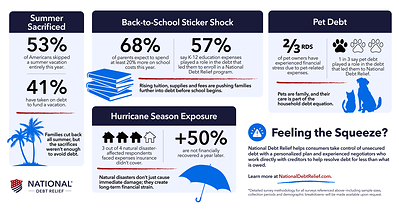
Taken together, the findings reveal a narrowing set of choices for already financially strained households. National Debt Relief clients reported cutting vacations, family visits, cookouts and gatherings during the summer. Fall brings new school year purchases, disaster recovery planning as hurricane season continues, and pet care budgeting, leaving fewer discretionary categories available to trim.
“For households already managing credit card balances, personal loans or other financial obligations, the challenge becomes deciding which remaining expenses or essential purchases are possible,” said Brit Simon, Chief Experience Officer, National Debt Relief. “These findings show how expenses beyond recurring monthly bills collide within the same household budget, leaving families with fewer places to cut and a greater risk of taking on more debt.”
The Summer ‘Debtcation’: Why Did Families Give Up Vacations This Year?
Survey data from 2,323 National Debt Relief clients** found that nearly eight in 10 planned to cut summer spending “a lot” or eliminate certain expenses altogether. Fifty-three percent said they were skipping a summer vacation entirely.
- Leisure Was the First to Go: 52% were cutting tourism and leisure trips.
- Family Time Also Sacrificed: 39% cut back family visits.
- Social Gatherings Shrink: 37% were limiting cookouts, gatherings and other entertaining-related expenses.
For some respondents, vacation costs did not end when the trip did.
- Vacation Debt Can Outlast the Trip: 41% had taken on debt to fund a vacation at some point.
- Borrowing Left Lasting Regret: 32% had incurred vacation debt and regretted it.
“These findings show that many had already given up vacations, family visits and social gatherings before summer even started,” said Cathleen Bell, Vice President, Customer Research & Insights, National Debt Relief. “With essential costs continuing to strain household budgets, many clients remain concerned about how far their money will stretch.”
Back-to-School Sticker Shock: How Are Parents Paying for School Expenses?
A July 2026 National Debt Relief survey** offers a current view of how financially vulnerable families are managing back-to-school spending. Among 4,087 clients surveyed, 711 were parents or legal guardians of school-aged children. Of those parents, 82% could estimate their expected back-to-school spending.
- Costs Are Climbing: Among parents able to estimate their spending, 68% expect to spend at least 20% more this year.
- Families Are Stretching Every Dollar: 83% are making changes to save money on back-to-school shopping, including waiting for sales or delaying purchases (33%), reusing backpacks or supplies (32%), skipping purchases altogether (29%) and shopping at discount or dollar stores (29%).
- Credit Is Bridging the Cash Gap: About 21% plan to use credit cards or Buy Now Pay Later (BNPL). Among those respondents, 64% said they lack enough cash or savings to pay the full cost upfront, while 57% want to spread out payments to ease the financial burden.
- Financial Stress Is Already High: 39% find back-to-school shopping very stressful on their finances.
- The Full School Year Feels Uncertain: One in four are not very confident they can cover all education-related costs for the 2026-2027 school year.
- School Costs Are Contributing to Debt: 57% said K-12 education-related expenses played at least some role in accumulating the debt they later enrolled in National Debt Relief’s debt settlement program.
“For families already operating on tight budgets, back-to-school shopping is not just another seasonal expense; it can reshape the entire household budget,” said Bell. “When school necessities require families to dip into savings or rely on credit, it becomes even harder to prepare for the unexpected.”
Weathering the Unexpected: How Are Families Recovering From Natural Disasters?
In a survey of more than 3,000 National Debt Relief clients** currently enrolled in the company’s debt settlement program, the data exposed how natural disasters can pose long-tail financial difficulty that rarely receives attention once the weather clears and the news cycle moves on.
Nearly one in five (17%) clients reported being impacted by a natural disaster, and nearly one in 10 (7%) reported being impacted by a natural disaster within the last three years.
- Recovery Takes Time: More than half (54%) of those affected by a natural disaster in the past year are still struggling to get back on their feet.
- Long-Term Effects Persist: Even among those impacted two to three years ago, 42% have yet to fully recover financially.
- Insurance Gaps Are Significant: Three out of four disaster-affected respondents faced expenses insurance did not cover, revealing a massive protection gap.
- Costs Add Up Quickly: One in five faced disaster-related expenses exceeding $10,000.
- Home Repairs Lead the Financial Fallout: Half of respondents (50%) with uninsured expenses cited home repairs as the number one financial consequence.
- Income Also Disrupted: Income disruption ranked second at 32%, showing that disasters can affect both what people own and what they earn.
“The financial impact of a natural disaster often lasts far longer than the storm itself,” Bell said. “For consumers already carrying significant unsecured debt, recovering financially and preparing for the next emergency can feel like competing priorities. Taking steps to reduce debt and build an emergency fund can make it easier to regain financial stability and build greater resilience for the future.”
Pet Debt: What’s the Impact of Pet Care Costs on Debt?
A new National Debt Relief survey** found that pet care is creating yet another source of financial pressure for households already managing debt. Among 1,629 clients surveyed, 1,053 reported spending money on pets within the past five years.
- Financial Stress Runs High: Two-thirds of respondents (67%) who spent money on pets experienced financial stress due to pet-related expenses.
- Families Are Making Tradeoffs: Half made financial adjustments to cover pet expenses, including 24% who cut back on personal spending and 11% who delayed paying down debt.
- Pet Costs are Driving New Debt: 29% borrowed money, used credit cards or took out a loan to cover pet expenses, and nearly half of those respondents incurred between $1,000 and $4,999 of debt. One-third (33%) of all respondents said pet-related debt played at least some role in accumulating the debt they later enrolled in National Debt Relief’s debt settlement program to address.
“Pets are family, which means their care is often treated as essential even when the household budget is already under strain,” added Bell. “An unexpected veterinary bill or ongoing pet medication can force families to postpone goals, reduce other essential spending or rely on credit. The financial decision may be difficult, but for many pet owners, leaving a family member without care does not feel like a choice.”
When There Is Little Left to Cut, What Can Consumers Do Next to Manage Debt?
The question facing many consumers is no longer whether financial compromises are necessary, but whether they are sustainable. As everyday expenses continue to rise, National Debt Relief encourages consumers to take stock of their finances before new bills arrive by:
- Planning ahead: Map upcoming school, transportation, insurance and seasonal expenses before they become urgent.
- Protecting essentials: Prioritize housing, utilities, food, transportation, insurance and healthcare before discretionary spending.
- Reviewing debt: Understand balances, interest rates and minimum payments, and avoid relying on new credit to cover everyday expenses.
- Seeking help: If unsecured debt is becoming unmanageable, debt settlement is a solution to consider. National Debt Relief’s program helps eligible consumers with $7,500 or more in unsecured debt, including credit card debt, medical bills or personal loans, resolve debt for less than they owe and avoid bankruptcy with affordable monthly payments that fit their budget. Learn more at NationalDebtRelief.com or call 1-800-718-0487 for a free, no-obligation consultation.
“No one should feel like they are out of options to get out from under debt,” added Simon. “The earlier consumers take steps to address financial challenges, be that adjusting their budget, building savings or exploring solutions to overcome overwhelming unsecured debt, the sooner they are able to regain control and build a stronger financial future.”
About National Debt Relief
Since 2009, National Debt Relief has helped people face their debt with confidence. As the debt settlement industry leader, we make the process of getting out of debt less overwhelming and more empowering. National Debt Relief is a Better Business Bureau A+ accredited business, Forbes Advisor’s top-rated debt relief company for four consecutive years and is the most highly reviewed and rated debt settlement company on ConsumerAffairs. We have helped over 1.3 million people take meaningful steps toward resolving their debt so they can feel financially and emotionally whole again. Learn more at NationalDebtRelief.com.
References and Methodology
* Forbes Advisor 2026. See: https://www.forbes.com/advisor/debt-relief/best-debt-relief-award/?award=best-debt-relief-companies-award-2026-national-debt-relief.
**Detailed survey methodology for all surveys referenced above—including sample sizes, collection periods and demographic breakdowns—will be made available upon request.
 View original content to download multimedia:https://www.prnewswire.com/news-releases/after-sacrificing-summer-financial-threats-continue-for-consumers-in-debt-302856859.html
SOURCE National Debt Relief