Vadzo Imaging has completed platform validation of the Bolt-821CRS, an 8MP color MIPI CSI-2 camera built on the Onsemi AR0821 sensor, confirming stable capture and driver behavior when interfaced directly with Rockchip RV1126 vision processor boards. The camera pairs an 8MP color sensor with on-chip HDR and a native MIPI CSI-2 output, removing the USB bridge chip that many embedded camera modules still rely on. Validation covered continuous streaming, resolution switching, and exposure stability across RV1126-based carrier boards used for edge AI and embedded vision development.
CHICAGO, IL / ACCESS Newswire / September 29, 2026 / Vadzo Imaging, a global leader in embedded vision camera products, today announced the completion of platform validation for the Bolt-821CRS AR0821 Color MIPI CSI-2 Camera. The Bolt-821CRS is built on the Onsemi AR0821 sensor and joins Vadzo’s MIPI camera portfolio. It pairs 8MP color imaging with on-chip HDR and a native MIPI CSI-2 output validated for direct interface with Rockchip RV1126 vision processor boards. The validation program targeted embedded AI and machine vision designs where the camera connects straight to the processor’s CSI-2 input rather than through a USB bridge, and where image quality and driver stability both matter for a production-ready design. With this validation, Vadzo delivers an 8MP Color MIPI CSI-2 Camera that removes interface uncertainty from RV1126-based hardware programs and gives integrators a sensor board that is ready to connect and stream on day one.
The MIPI to RV1126 Integration Problem
Embedded vision teams building around the Rockchip RV1126 vision processor face a narrower sensor selection problem than teams working with USB. A USB camera hides its interface complexity behind a UVC driver, but a MIPI CSI-2 camera exposes raw sensor timing, lane configuration, and register level behavior directly to the host processor. That direct exposure is also what makes MIPI attractive for a finished product, since it removes a bridge chip and its associated cost, board space, and latency, but it also means the sensor vendor’s validation work matters far more than it does on a plug and play USB peripheral. Three problems come up repeatedly when pairing a MIPI sensor board with an RV1126 design.
Driver and timing mismatch is the first. Many MIPI camera boards on the market were validated against a different processor family, and the CSI-2 lane count, clock speed, or MIPI D-PHY timing does not always match what an RV1126-based carrier board expects out of the box. Engineering teams often spend weeks bringing up hardware before a supposedly compatible sensor produces a clean image on an RV1126 platform. An MIPI Color Camera for RV1126 that has not been validated on the actual processor leaves that bring-up work entirely on the integrator’s side.
Image signal processing tuning is the second problem. The RV1126 has its own onboard ISP pipeline, and a color sensor that was tuned for a different host ISP can arrive with washed-out color, incorrect white balance, or noisy output once it reaches the RV1126 image pipeline. An RV1126 Color Vision Sensor needs sensor-level tuning data that matches how the RV1126 ISP expects to receive raw Bayer data, not a generic configuration ported from an unrelated platform.
Power and thermal budget is the third problem, particularly for RV1126 designs going into compact enclosures such as drones, kiosks, or battery-powered edge AI devices. A camera board drawing more current than the design budget allows forces a redesign of the power rail or the enclosure. An RV1126 CSI-2 Sensor Kit that has not been characterized for operational power draw leaves system designers guessing at a specification that directly affects battery life and thermal headroom.
An RV1126 High Res Camera Module that has been validated on real RV1126 hardware, with confirmed timing, tuned ISP behavior, and documented power draw, removes all three unknowns before a design review rather than after months of field issues. That distinction, validated before purchase instead of discovered after integration begins, is increasingly what separates a sensor vendor’s marketing claim from a specification an embedded hardware team can actually design around.
Why MIPI CSI-2 Validation on RV1126 Matters
An AR0821 Color MIPI CSI-2 Camera is only as useful to an RV1126 program as the validation work behind it. Vadzo built the Bolt-821CRS around the Onsemi AR0821 sensor specifically because its rolling shutter architecture, on-chip HDR, and color pipeline suit the kind of general-purpose embedded AI and machine vision work that RV1126 designs are typically built for, and then validated the resulting sensor board directly against RV1126 carrier hardware rather than relying on a generic MIPI compatibility claim.
MIPI CSI-2 lane configuration is the foundation of that validation. The Bolt-821CRS outputs raw Bayer data over a confirmed lane count and clock rate that matches RV1126 CSI-2 receiver expectations, so the sensor produces a stable image on first connection rather than requiring timing adjustments in the field. An AR0821 CSI-2 RV1126 Sensor validated this way removes one of the most common sources of integration delay on embedded vision hardware.
ISP tuning is layered on top of that interface work. Vadzo characterized the AR0821 output against the RV1126’s onboard ISP pipeline, adjusting gain curves and color correction so that raw sensor data arrives already close to production color accuracy rather than requiring extensive manual tuning on the host side. An 8MP RV1126 CSI-2 Sensor tuned this way saves integration teams from redoing color science work that Vadzo has already validated.
Power characterization closes the loop. The Bolt-821CRS was measured for operational current draw across active streaming and idle states so that designers working on compact RV1126 platforms, including drone payloads and battery-powered kiosks, can budget power and thermal headroom with confirmed numbers instead of estimates. An 8MP RV1126 Sensor Module documented this way turns a hardware unknown into a specification a design review can rely on.
Vadzo also documented the resolution and frame rate combinations the Bolt-821CRS supports when paired with the RV1126’s onboard scaler, so integrators can choose between full 8MP capture for detail-sensitive tasks and a downscaled stream for lighter-weight inference without guessing at what the processor and sensor combination can actually sustain. This kind of paired characterization, sensor and processor tested together rather than each evaluated in isolation, is what separates a genuinely validated RV1126 camera board from one that simply lists MIPI CSI-2 on a specification sheet.
Product Overview
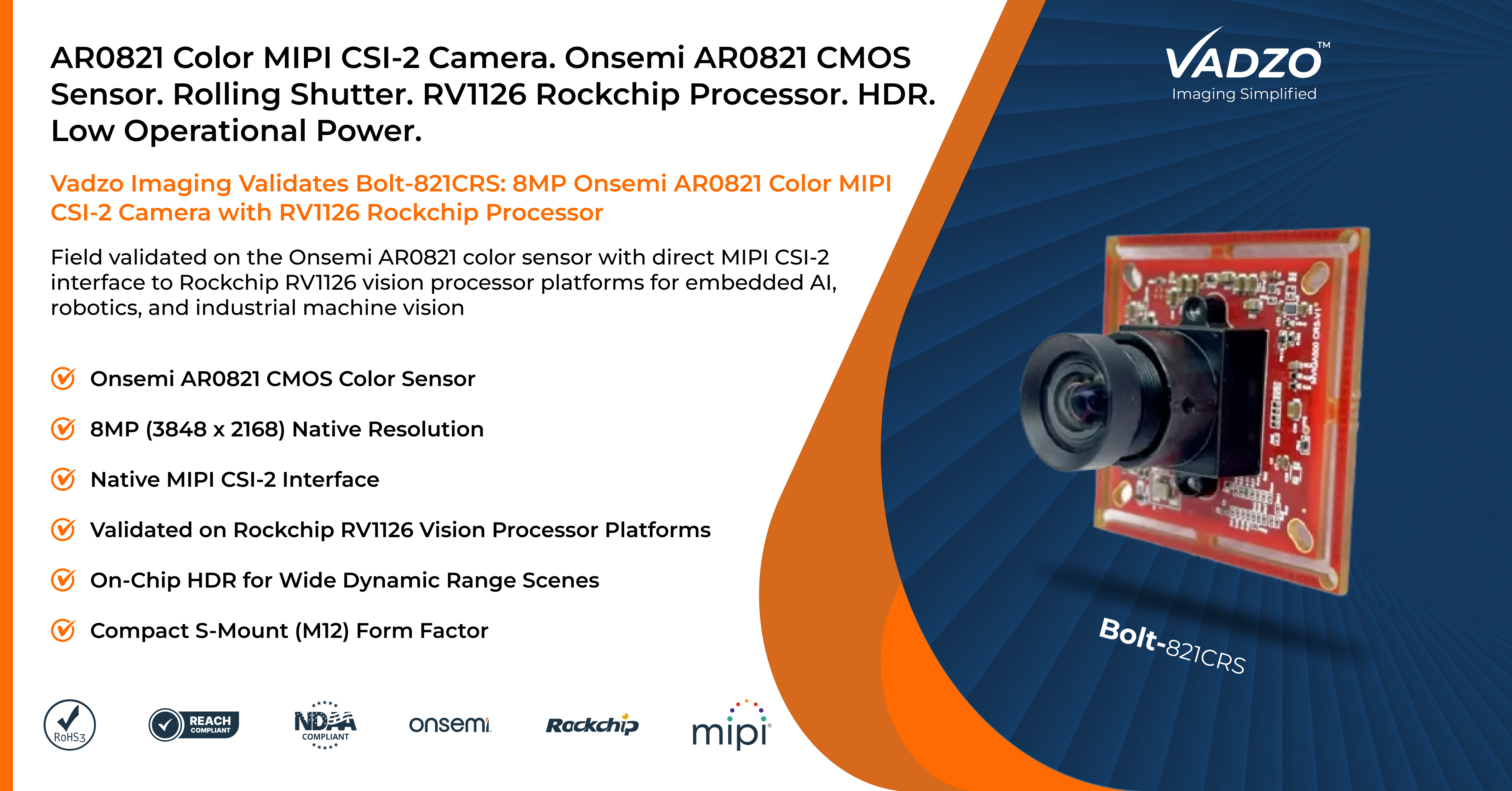
The Bolt-821CRS is an 8MP AR0821 Color MIPI Camera built on the Onsemi AR0821 CMOS sensor and engineered for direct MIPI CSI-2 connection to embedded vision processors. The AR0821 is an 8MP (3848 x 2168) color rolling shutter sensor with a 1/1.7 inch optical format and a 2.1-micron pixel that delivers on-chip HDR for scenes with mixed bright and shadowed regions. This combination of resolution, color accuracy, and dynamic range makes the Onsemi AR0821 RV1126 Sensor a practical fit for embedded AI camera designs that need both image quality and a documented processor interface.
The Bolt-821CRS houses the sensor and an S-Mount (M12) lens holder on a compact board designed to connect directly to a MIPI CSI-2 receiver, with no USB bridge chip and no additional interface board required. Vadzo validated the module against Rockchip RV1126 vision processor carrier boards, confirming stable lane timing, clean color output through the RV1126 ISP pipeline, and documented power draw across streaming and idle states. RV1126 Rockchip processor camera integration work that would otherwise take an engineering team weeks of bring-up time is already completed before the board ships.
Vadzo Imaging developed the Bolt-821CRS after hearing directly from embedded AI hardware teams that generic MIPI camera modules rarely arrive already validated for the specific vision processor a design is built around. Rather than sell a sensor board with an unconfirmed compatibility claim, Vadzo tested the Bolt-821CRS on RV1126 reference hardware first, then published the validated timing, ISP tuning notes, and power figures alongside the camera so integrators can move directly from data sheet to design without a separate integration phase. This approach reflects a broader shift Vadzo has observed across its embedded vision customer base, where hardware teams increasingly prioritize documented, processor-specific validation over a longer feature list that has not been confirmed against their actual target platform.
Key specs: 8MP (3848 x 2168) | Onsemi AR0821 CMOS, 1/1.7-inch, 2.1-micron pixel | Color (Bayer RGB / YUV422) | Rolling Shutter with On-Chip HDR | MIPI CSI-2 | S-Mount (M12) Lens Mount | RV1126 Rockchip Processor
Key Capabilities of the Bolt-821CRS Color MIPI CSI-2 Camera
Native MIPI CSI-2 Interface Without a USB Bridge
Many embedded camera boards add a USB-to-MIPI bridge chip to simplify integration, which adds cost, latency, and another point of firmware failure. The Bolt-821CRS outputs raw sensor data directly over MIPI CSI-2, so an RV1126 Color MIPI Camera design connects the sensor straight to the processor’s CSI-2 receiver with no intermediate chip in the signal path. An RV1126 CSI-2 Camera Module built this way keeps latency lower and firmware simpler than a bridged USB alternative, which matters for real-time inference pipelines. Removing the bridge chip also trims bill of materials cost and frees board space, both of which matter to OEM programs building compact embedded AI products at volume.
Validated Timing on Rockchip RV1126 Platforms
An AR0821 RV1126 Rockchip MIPI Camera is only production-ready if its CSI-2 lane configuration and clock timing actually match the target processor. Vadzo confirmed the Bolt-821CRS against RV1126 reference carrier boards, verifying clean image capture on first connection without lane count or timing adjustments. This RV1126 Color Vision Sensor validation removes an integration step that otherwise consumes engineering time before a design can move to the next milestone.
ISP Tuning for Accurate Color Through RV1126
Raw sensor data is only as good as the tuning behind it once it reaches a host ISP. Vadzo characterized the AR0821 RV1126 Color MIPI Camera against the RV1126’s onboard image pipeline, adjusting gain and color correction curves so output color and exposure behavior match production expectations rather than requiring extensive manual calibration. An RV1126 CSI-2 Sensor Kit tuned this way shortens the path from first image to a shippable camera pipeline. Engineering teams that have previously integrated an untuned sensor into an RV1126 design know how many iteration cycles this kind of already validated tuning data can save, since color science work that is done once by the sensor vendor does not need to be repeated by every customer building on the same platform.
On-Chip HDR for Mixed Lighting Scenes
Embedded AI camera systems frequently operate in scenes with both bright and shadowed regions, from an industrial floor near a window to an outdoor kiosk under direct sun. The AR0821 sensor’s on-chip HDR captures a wider dynamic range in a single exposure, giving an AR0821 RV1126 Machine Vision pipeline usable detail in both highlight and shadow areas without a software tone mapping pass that can introduce artifacts or added latency.
8MP Resolution for High Detail Inference
An 8MP RV1126 Rockchip processor camera provides enough spatial resolution for fine detail inspection tasks while still allowing the RV1126’s onboard scaler to downsample for lighter weight inference models when full resolution is not required. This flexibility lets a single RV1126 8MP Vision Sensor design serve both high-resolution recording and lower-resolution real-time analytics from the same camera board without swapping hardware. An 8MP RV1126 Color Camera configured this way gives a product line one sensor board to qualify across multiple resolution tiers instead of stocking a separate part number for each output mode.
Compact S-Mount Form Factor for Embedded Designs
The Bolt-821CRS ships in a compact S-Mount (M12) board camera footprint sized for enclosures where board space is limited, including drone payload bays, kiosk camera housings, and compact industrial inspection stations serving RV1126 Color Industrial Camera deployments. Vadzo offers cable length and connector customization for OEM orders, letting integrators match the board to a specific RV1126 carrier design rather than adapting their enclosure around a fixed cable length. An OEM RV1126 Color Module program with unique mounting or connector requirements can work directly with Vadzo’s engineering team to adapt the standard board without a full custom sensor design.
“Teams building on Rockchip RV1126 kept running into the same wall. A MIPI camera would claim compatibility on paper, then arrive with timing that did not match the CSI-2 receiver or color that needed weeks of tuning before it looked right. The Bolt-821CRS exists because we tested the Onsemi AR0821 sensor directly against RV1126 reference hardware before publishing a single specification. Validation confirmed stable timing, tuned color through the RV1126 ISP, and documented power draw. That is exactly what an embedded AI hardware program needs from a camera vendor: proof the board works on the actual processor rather than a generic MIPI compatibility claim.” – Alwin Vincent, Product Manager, Vadzo Imaging.
Application-Specific Sections
Embedded AI and Edge Vision Platforms
RV1126-based hardware is a common foundation for edge AI camera products, and an RV1126 Color Edge AI Camera needs to deliver clean color data straight into the processor’s onboard NPU pipeline without added interface latency. The Bolt-821CRS connects over native MIPI CSI-2 and streams tuned color output that inference models can consume directly, letting developers spend their engineering time on model performance rather than sensor bring-up work. An AR0821 RV1126 Embedded Vision design built around a validated sensor board shortens the path from prototype to field deployment for edge AI products.
Robotics and Machine Vision
Robotics platforms built on RV1126 processors need a color sensor that performs consistently across the mixed indoor and outdoor lighting many mobile platforms encounter. An RV1126 Color Robotics Camera benefits from the AR0821’s on-chip HDR and validated ISP tuning, giving a navigation or object recognition pipeline stable image quality without additional exposure correction logic running on the host processor. An AR0821 RV1126 Machine Vision station built on the Bolt-821CRS also suits fixed inspection setups that require documented, repeatable sensor behavior across every unit in a production line.
Vision system integrators building a complete RV1126 Color Vision System around this sensor benefit from Vadzo’s published timing and power data, which removes guesswork from bill of materials planning and lets a hardware review proceed with confirmed specifications rather than a vendor’s marketing claim. This matters most for programs that need to qualify a sensor once and then carry that qualification across multiple product variants without repeating the integration process for each new enclosure or carrier board revision.
Security and Network Video Recording
Network video recording platforms built on RV1126 processors need reliable color capture across day and interior lighting conditions. An RV1126 Color NVR Camera built on the Bolt-821CRS benefits from the sensor’s on-chip HDR and validated RV1126 ISP tuning, delivering consistent exposure without the frame drops that an unvalidated CSI-2 timing mismatch can introduce during continuous recording. Multichannel recorder designs that pair several sensor boards to a single RV1126 processor also benefit from unit-to-unit consistency, since every Bolt-821CRS board ships against the same tuning profile rather than requiring individual calibration.
Drone and UAV Payloads
Drone platforms running RV1126-based flight computers need a lightweight, low-power camera board that does not strain the aircraft’s power or weight budget. An RV1126 Color Drone Camera built on the Bolt-821CRS ships with documented power draw figures, letting airframe designers calculate battery impact before committing to a sensor choice rather than discovering a power shortfall during flight testing. The sensor’s on-chip HDR also helps aerial imagery hold detail across the wide brightness range common between open sky and shadowed ground terrain in a single frame.
Kiosk and Digital Signage Vision
Interactive kiosks and digital signage platforms built on RV1126 processors need a compact camera that delivers accurate color under variable indoor lighting and lighting near storefront windows. An RV1126 Color Kiosk Camera built on the Bolt-821CRS uses the AR0821’s on-chip HDR to hold detail in both bright storefront windows and dimmer interior lobbies, supporting face detection, audience analytics, and interactive display applications from a single validated sensor board.
Frequently Asked Questions
Q. What is the advantage of a MIPI CSI-2 camera over a USB camera for an embedded vision board?
A: A MIPI CSI-2 camera connects directly to a processor’s camera receiver without a USB controller or bridge chip in the signal path, which typically means lower latency, simpler firmware, and fewer components on the bill of materials. Vadzo Imaging designs its MIPI camera boards to output raw sensor data straight into the host processor’s image pipeline, which is why embedded AI and robotics teams building compact, power-sensitive hardware often choose a MIPI interface over USB once board space and response time start to matter. The trade-off is that a MIPI sensor needs proper validation against the specific target processor to work correctly, which is exactly the gap Vadzo Imaging fills for customers building on Rockchip platforms.
Q. Does Vadzo Imaging’s color MIPI camera work directly with Rockchip-based vision processors?
A: Yes. Vadzo Imaging validates its color MIPI camera boards directly on Rockchip RV1126 reference hardware rather than relying on a generic compatibility claim, confirming CSI-2 lane timing and color output through the RV1126 image pipeline before the board ships. This is one of the reasons engineering teams turn to Vadzo Imaging for Rockchip-based designs: the validation work is already done, which removes a common source of delay during hardware bring-up.
Q. Can this MIPI camera support on-device AI inference for edge vision projects?
A: Yes. Vadzo Imaging’s color MIPI camera streams tuned image data directly into a host processor’s onboard neural processing pipeline, which is exactly the configuration edge AI camera products rely on for real time inference. Because Vadzo Imaging handles sensor tuning and interface validation ahead of time, developers can point their inference models at a stable camera feed and focus engineering effort on model accuracy rather than image pipeline debugging. This matters most for products that need to run detection or classification models directly on the device rather than sending video to a remote server for processing.
Q. Does Vadzo Imaging provide driver and BSP support for integrating a MIPI camera on an embedded Linux platform?
A: Yes. Vadzo Imaging provides sensor driver guidance and board support package documentation for integrating its MIPI camera products on embedded Linux platforms, including the register-level tuning data needed for a clean image straight out of the box. Vadzo Imaging’s engineering team also supports OEM customers with platform-specific integration assistance, which is particularly valuable for teams that have not previously integrated a raw MIPI sensor into a custom hardware design.
Q. Is Vadzo Imaging’s MIPI CSI-2 camera small enough for compact products like kiosks or drones?
A: Yes. Vadzo Imaging’s MIPI CSI-2 camera ships in a compact board camera footprint designed for space-constrained enclosures, including kiosk housings, drone payload bays, and handheld devices where every cubic centimeter matters. Vadzo Imaging also documents power draw for the module, so hardware designers working on battery-powered or thermally constrained products can plan their enclosure and power budget around confirmed figures rather than estimates. This combination of a small footprint and known power behavior is why Vadzo Imaging sees strong adoption of this camera across product categories that have little tolerance for oversized or power hungry components.
Availability
The Bolt-821CRS AR0821 Color MIPI CSI-2 Camera is now available for evaluation and production orders following completion of RV1126 platform validation. As an RV1126 Rockchip MIPI CSI-2 Camera, evaluation units include the camera board, an S-Mount lens, and RV1126 integration documentation covering timing, ISP tuning notes, and power draw figures, with no minimum order requirement. This RV1126 Color Camera Kit gives engineering teams everything needed to confirm image quality and driver behavior on their own carrier board before committing to a production order. Vadzo Imaging supports cable, connector, and lens customization for OEM embedded AI and robotics programs. Browse the full Vadzo MIPI camera portfolio at https://www.vadzoimaging.com/ or contact Vadzo Imaging at alwin@vadzoimaging.com to request an evaluation unit or discuss production volume requirements.
About Vadzo Imaging
Vadzo Imaging is a global provider of embedded vision solutions and an RV1126 Camera Manufacturer delivering high-performance camera technologies and imaging platforms for applications in robotics, industrial automation, embedded AI, edge vision, and medical systems. Its products are designed for seamless integration with leading embedded platforms, including Rockchip, NVIDIA, and NXP processor families. Vadzo Imaging supports customers through hardware customization, firmware development, and module-level drivers, enabling faster development and deployment of vision-based systems.
Media Contact
Alwin Vincent
Vadzo Imaging
Email: alwin@vadzoimaging.com
LinkedIn: Vadzo Imaging
YouTube: Vadzo Imaging
X: Vadzo Imaging
SOURCE: Vadzo Imaging
View the original press release on ACCESS Newswire
Media gallery