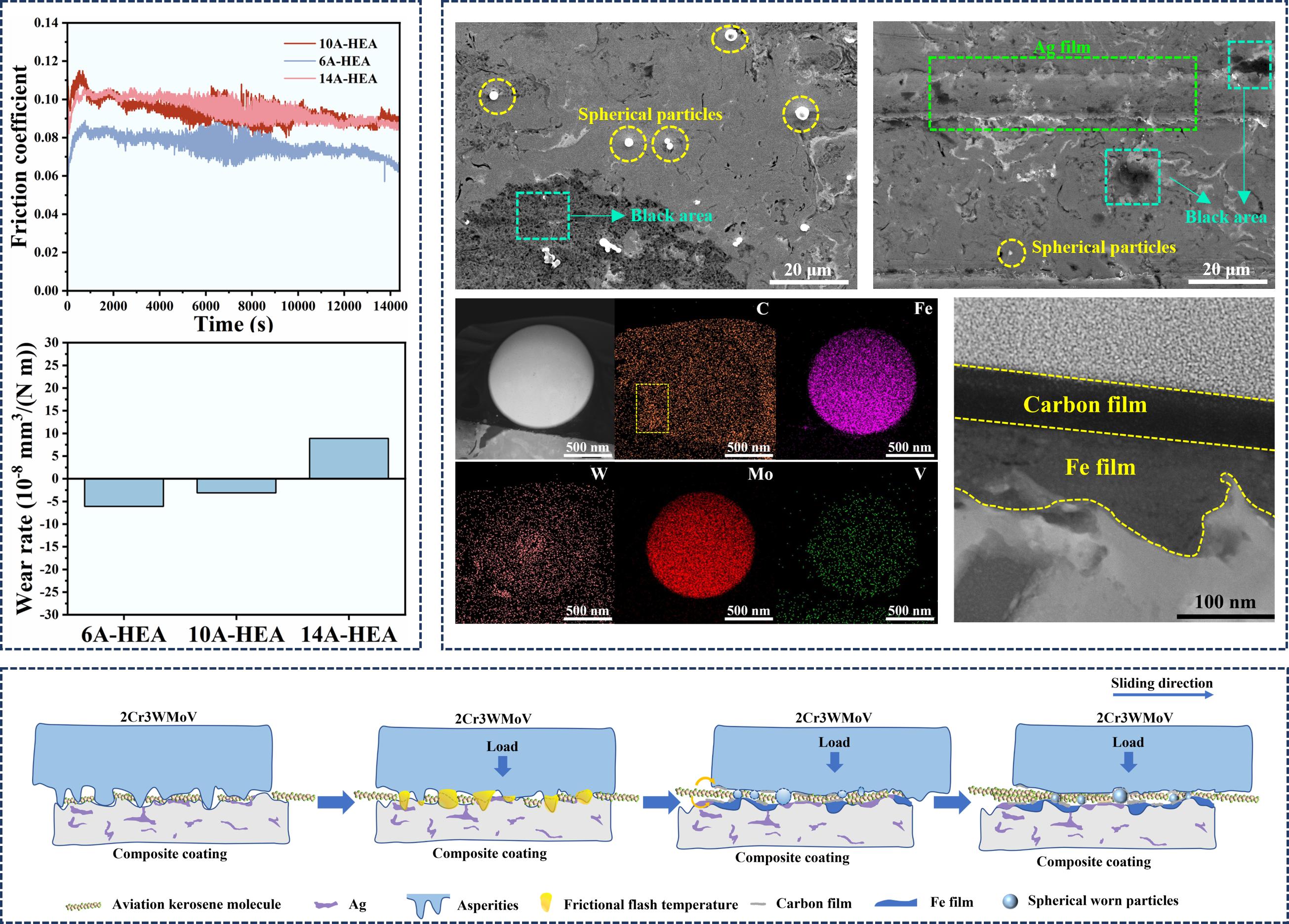
GA, UNITED STATES, October 12, 2026 /EINPresswire.com/ — This study leverages the advantages of FCC-structured metallic alloys in terms of energy absorption during plastic deformation and low shear-induced friction reduction. A novel Al10Cr28Co28Ni34/Ag high-entropy alloy composite coating was designed and fabricated via high-velocity oxygen fuel (HVOF) spraying. Benefiting from the fact that both constituent phases share an FCC structure, the coating exhibits similar response behaviors when subjected to external forces such as friction and impact. Furthermore, combined with the rolling effect of spherical particles formed in situ at the friction interface, the coating achieves excellent synergistic lubrication, wear resistance, and cavitation erosion protection in low-viscosity aviation kerosene: a friction coefficient below 0.1, a wear rate approaching zero, and a cavitation erosion mass loss rate of less than 0.1 mg/h. These findings offer a new perspective for addressing the common challenge of combined wear and cavitation erosion damage in friction pairs of aero-engine fuel pumps. The related research findings are published in “Tribology Advances” under the title “FCC/FCC structural compatibility enabling synergistic lubrication, anti-wear and cavitation erosion of Al10Cr28Co28Ni34/Ag composite coating in aviation kerosene.”
Background
As the “heart” of an aero-engine, the performance and reliability of the fuel pump directly affect flight safety. The thrust bearing is a critical support component inside the pump, which bears the axial load transmitted from the gears through end-face contact, maintains positioning accuracy, and provides sealing. Aviation kerosene has an extremely low viscosity, making it difficult to form a continuous and stable oil film at the contact interface between the bearing and the gears under high-speed rotation. This not only readily leads to lubrication failure and bearing wear, but also easily induces cavitation, causing cavitation erosion damage, ultimately affecting the fuel delivery efficiency.
Although existing coating materials, represented by bonded solid lubricating coatings (BSLCs), can address the problem of wear under oil-starved conditions, they struggle to simultaneously provide cavitation erosion protection. The key difficulties lie in: I) the matrix phase of traditional coatings, such as organic resins, has insufficient strength and poor heat resistance, making them prone to fracture failure under the combined action of intense impact loads and cavitation heat generated by bubble collapse; II) the substantial property mismatch between the matrix phase and the lubricating phase leads to incompatible deformation behaviors under external forces, causing cracking at phase boundaries and accelerating the selective removal of lubricant fillers; III) conventional materials used as the coating matrix phase find it difficult to achieve a balance between friction reduction, wear resistance, and cavitation erosion resistance.
Through a literature review of metallic materials that exhibit good lubricating properties and cavitation erosion resistance, we found that most of them are predominantly FCC‑structured, including solid lubricants (e.g., Au, Ag, Cu) and cavitation erosion-resistant alloys such as aluminum bronze, nickel-aluminum bronze, and the Al10Cr28Co28Ni34 high-entropy alloy (HEA). This is likely attributable to the abundant slip systems in FCC structures, which promote slip under shear forces and accommodate greater deformation under impact loading, thereby reducing friction and dissipating impact energy, respectively. Owing to the four core effects, the Al10Cr28Co28Ni34 HEA not only possesses the high work-hardening capacity intrinsic to FCC metals but also exhibits substantially higher strength than conventional FCC counterparts. This allows it to confine deformation caused by load impact within a certain range, resulting in exceptionally excellent cavitation erosion resistance. Inspired by this, the present work(doi: https://doi.org/10.3724/trad-20260019) proposes a research approach that exploits the structural compatibility between the Al10Cr28Co28Ni34 HEA and Ag to design and fabricate a composite coating integrating lubricating, wear resistance and cavitation erosion protection, aiming to more effectively address the combined damage caused by wear and cavitation erosion in fuel pump friction pairs.
Highlights
Proposed FCC/FCC structural compatible design to reduce cavitation erosion and wear
Coordinated structure response to force yields uniform to fatigue-resistant coating
HEA’s load-bearing and Ag’s low-shear film formation solves oil-starved lubrication
Formation of spherical particles and rolling-sliding mechanism have been proved
Achieving near-zero wear and long-term cavitation erosion resistance in one coating
DOI
10.3724/trad-20260019
Original Source URL
https://doi.org/10.3724/trad-20260019
Funding information
This research was financially supported by the National Science and Technology Major Project (Grant No. J2022-VI-0006-0037), the National Natural Science Foundation of China, China (Grant No. 52175200), the Strategic Priority Research Program of the Chinese Academy of Sciences, China (Grant No. XDB0470102), the Youth Innovation Promotion Association of the Chinese Academy of Sciences, China (Grant No. 2020416), and the Longyuan Youth Talent Project. The authors appreciate the helpful comments of reviewers.
Lucy Wang
BioDesign Research
Legal Disclaimer:
EIN Presswire provides this news content “as is” without warranty of any kind. We do not accept any responsibility or liability
for the accuracy, content, images, videos, licenses, completeness, legality, or reliability of the information contained in this
article. If you have any complaints or copyright issues related to this article, kindly contact the author above.

Media gallery