
Shenzhen,Guangdong, China – November 18, 2026
The automotive emergency power market is evolving as drivers, workshops, fleet operators, and automotive brands look for more practical ways to deal with unexpected battery problems.
Portable lithium battery jump starters remain an important part of the market. However, supercapacitor technology is attracting attention as an alternative for certain emergency starting applications, particularly where temperature tolerance, charging flexibility, and long service life matter.
For automotive brands, importers, distributors, and wholesalers, understanding these automotive power trends can help identify new product opportunities and make better sourcing decisions.
So, why are supercapacitor jump starters becoming more relevant, and what should buyers consider before adding them to their product portfolios?
1. How Is the Automotive Emergency Power Market Changing?
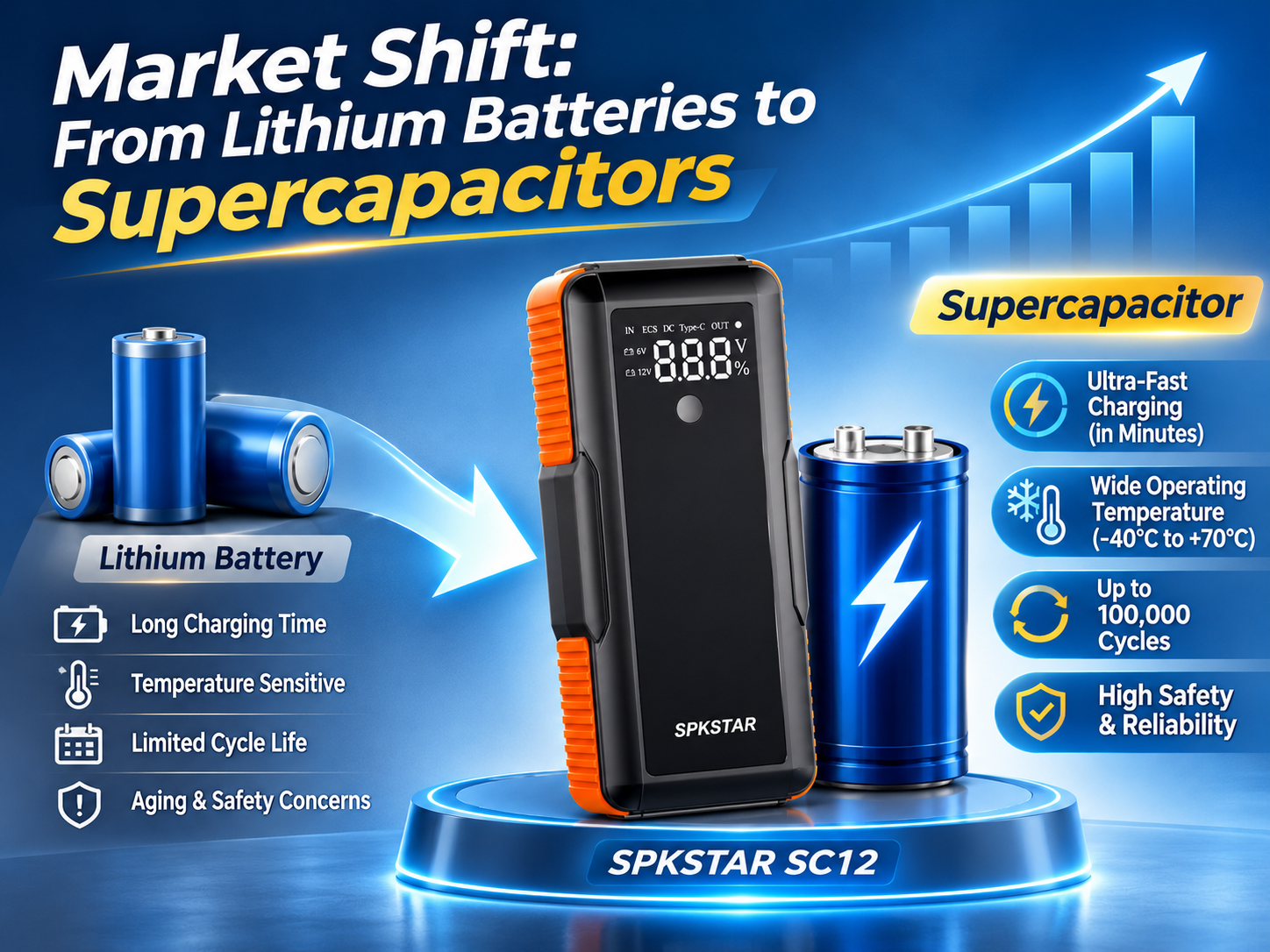
Automotive emergency products have expanded beyond traditional jumper cables and basic battery chargers. Buyers can now choose from compact lithium jump starters, multifunctional emergency power stations, portable tire inflators, and supercapacitor-based starting devices.
Several customer needs are influencing product development and purchasing decisions.
Greater Demand for Practical Emergency Equipment
Drivers want equipment that is easy to carry, straightforward to operate, and useful when a vehicle fails to start. Workshops and fleet operators also value products that can support emergency maintenance without requiring another vehicle to provide a jump start.
More Attention to Operating Conditions
Automotive emergency equipment may be stored in vehicles, workshops, service trucks, or outdoor environments. Temperature changes, storage periods, and charging availability can affect product performance and user experience.
As a result, buyers are paying closer attention to operating temperature specifications, maintenance requirements, and the conditions under which a product can deliver its advertised performance.
Growing Interest in Product Differentiation
For automotive aftermarket brands, offering another conventional jump starter may not be enough to stand out. Different energy-storage technologies, specialized applications, and thoughtful product design can create opportunities for more targeted product ranges.
2. What Is a Supercapacitor Jump Starter?
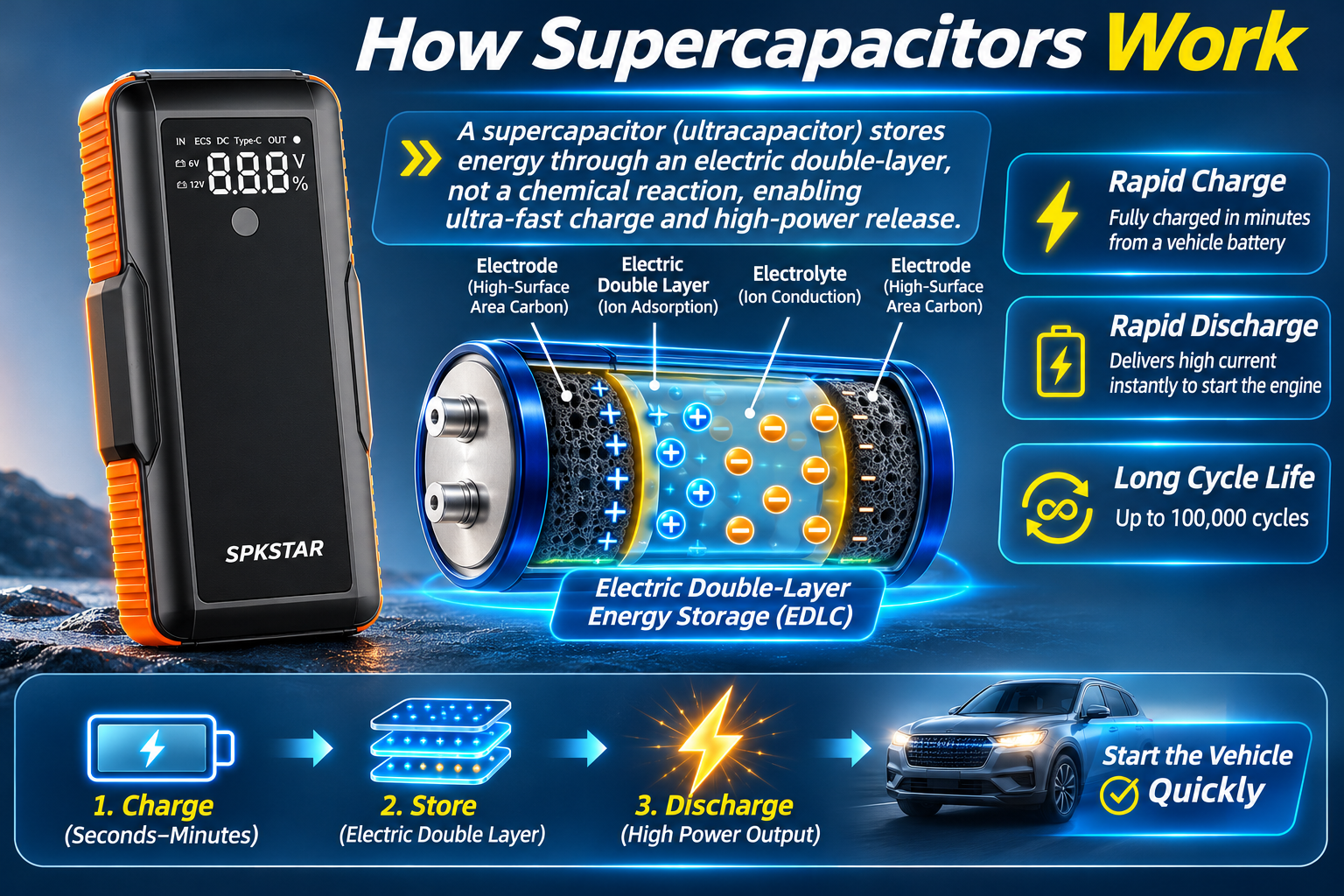
A supercapacitor jump starter uses high-capacitance energy-storage components to collect and release electrical energy. Unlike a conventional lithium battery jump starter, which stores energy in rechargeable battery cells, a capacitor-based device stores energy electrostatically.
One important characteristic of supercapacitors is their ability to deliver high power over short periods. This makes them suitable for applications that require a brief burst of electrical current, including certain engine-starting situations.
However, supercapacitor jump starters are not all designed in the same way. Charging methods, capacitor configurations, voltage compatibility, and starting capabilities vary by model.
How Does a Supercapacitor Jump Starter Charge?
Depending on the design, a supercapacitor jump starter may collect energy from a vehicle battery or an external charging source such as USB-C.
Some models can charge from a weak vehicle battery when sufficient usable energy remains. However, this does not mean every capacitor-only device can operate independently when the vehicle battery is completely discharged.
Buyers should verify the supported charging sources, minimum input voltage, charging time, and emergency starting procedure for each product.
3. Why Are Supercapacitors Attracting More Attention?
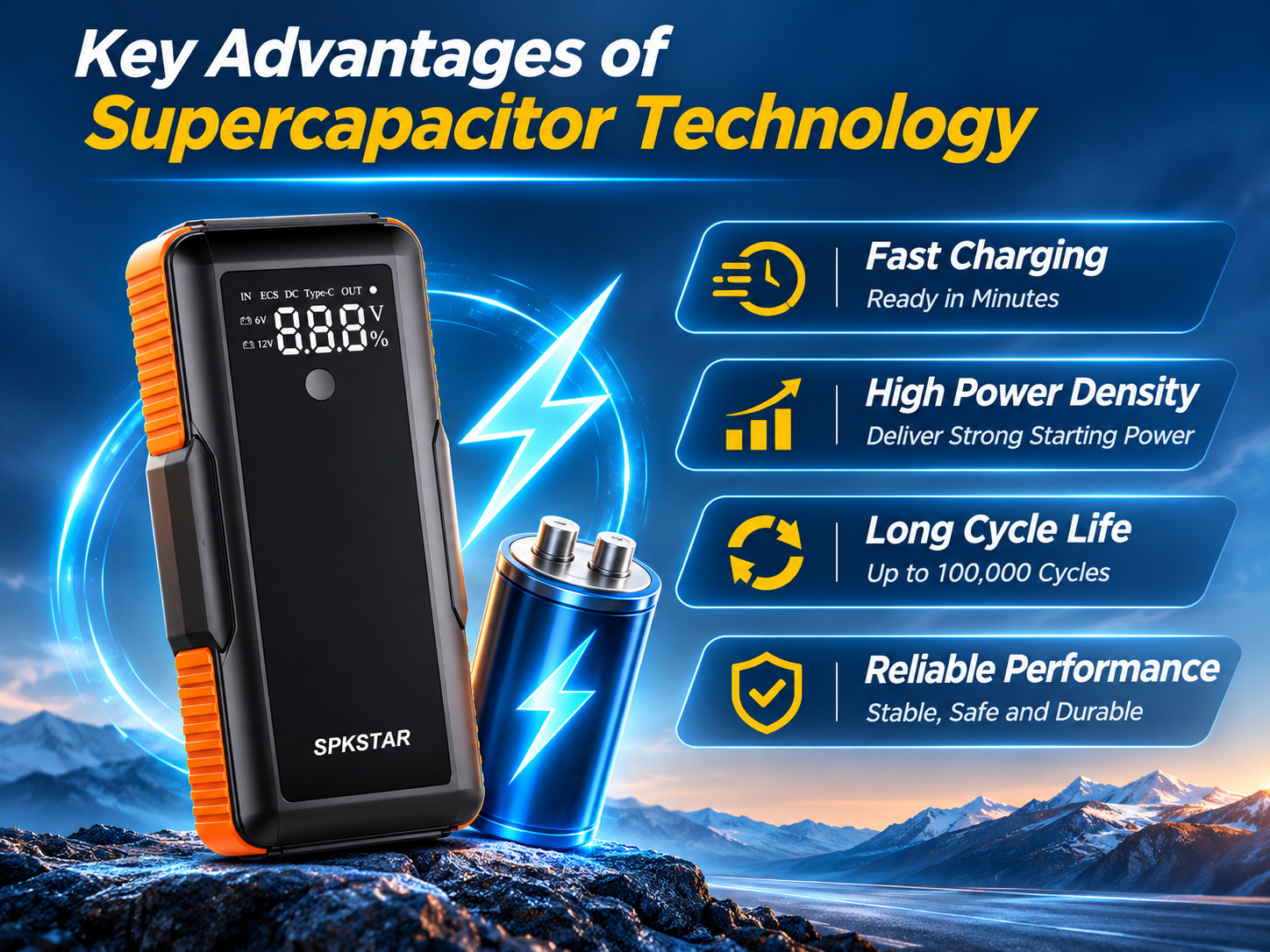
The growing interest in supercapacitor emergency power products is connected to several technical characteristics and practical application needs.
High Power Delivery for Short-Duration Starting
Starting an engine requires a substantial amount of electrical power over a relatively short period. Supercapacitors can be designed to deliver high current quickly, making them useful for suitable starting systems.
Actual starting performance depends on more than a published peak-current figure. Engine size, vehicle voltage, battery condition, temperature, and sustained cranking requirements all matter.
Wide Operating Temperature Potential
Temperature performance is another reason buyers consider supercapacitor technology.
SPKSTAR offers selected supercapacitor jump starter models with a specified operating temperature range of -40°C to +70°C. This can be relevant for buyers serving regions with severe winters or hot summers.
Operating temperature ratings should not be confused with guaranteed engine-starting performance at every temperature. Cold-start capability still needs to be evaluated under the intended vehicle and battery conditions.
Long Cycle-Life Characteristics
Supercapacitor components can support a high number of charge and discharge cycles compared with many rechargeable battery chemistries.
This characteristic may be valuable in professional environments where equipment is used frequently. However, the service life of a complete jump starter also depends on its electronics, connectors, housing, and operating conditions.
Different Storage and Maintenance Considerations
Battery-powered jump starters generally require periodic charging to maintain readiness. Capacitor-based models have different energy-storage and charging characteristics, which may appeal to users who prefer charging the device when needed.
Nevertheless, a supercapacitor unit is not automatically ready to start a vehicle after long-term storage. Users must understand its available charging options and follow the manufacturer’s operating instructions.
4. Supercapacitor vs. Lithium Jump Starters: What Are the Differences?
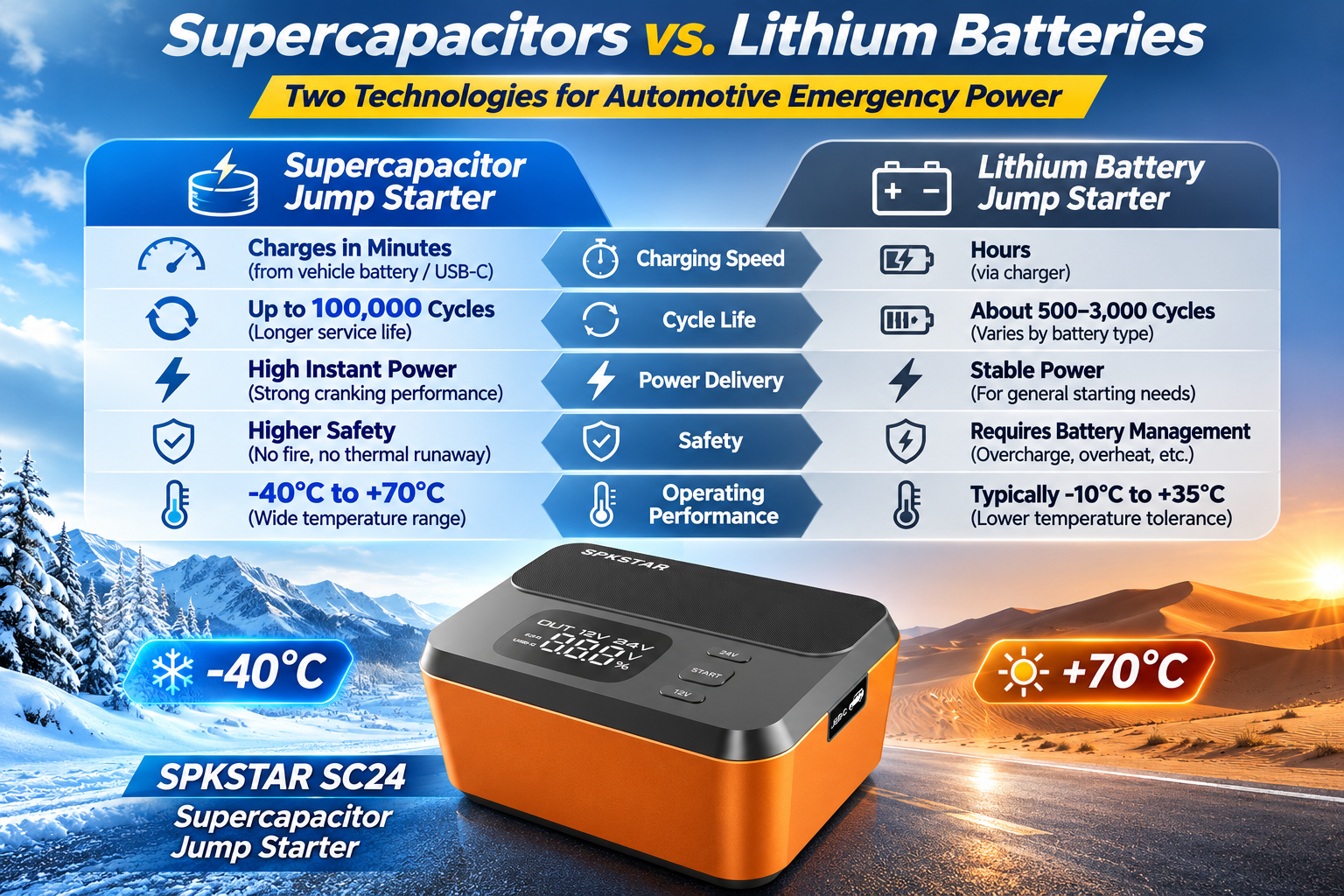
One of the most important automotive power trends is the development of different emergency power solutions for different user needs.
Supercapacitor and lithium battery jump starters are not direct substitutes in every situation. Each technology has advantages and limitations.
| Comparison | Supercapacitor Jump Starter | Lithium Battery Jump Starter |
|---|---|---|
| Energy Storage | Stores energy electrostatically in capacitors | Stores energy in rechargeable battery cells |
| Power Delivery | Well suited to high-power, short-duration output | Can provide starting power based on battery and circuit design |
| Charging | May use a vehicle battery or external source, depending on model | Typically requires recharging from an external power source |
| Stored Energy | Generally lower energy storage for a given size | Generally higher energy storage for a given size |
| Cycle Life | High cycle-life potential at component level | Varies with battery chemistry and usage |
| Additional Functions | Depends on the specific product design | Often supports USB charging, lighting, or other functions |
| Typical Buyer Interest | Specialized starting applications and charging flexibility | Self-contained emergency power and multifunctional use |
For distributors, the best choice depends on customer expectations. A consumer who wants a rechargeable emergency power bank may prefer a lithium model. A professional buyer interested in a different starting technology may want to evaluate a supercapacitor solution.
Offering both technologies can help an automotive brand serve a broader range of applications without presenting one as universally superior.
5. Where Can Supercapacitor Jump Starters Create Market Opportunities?
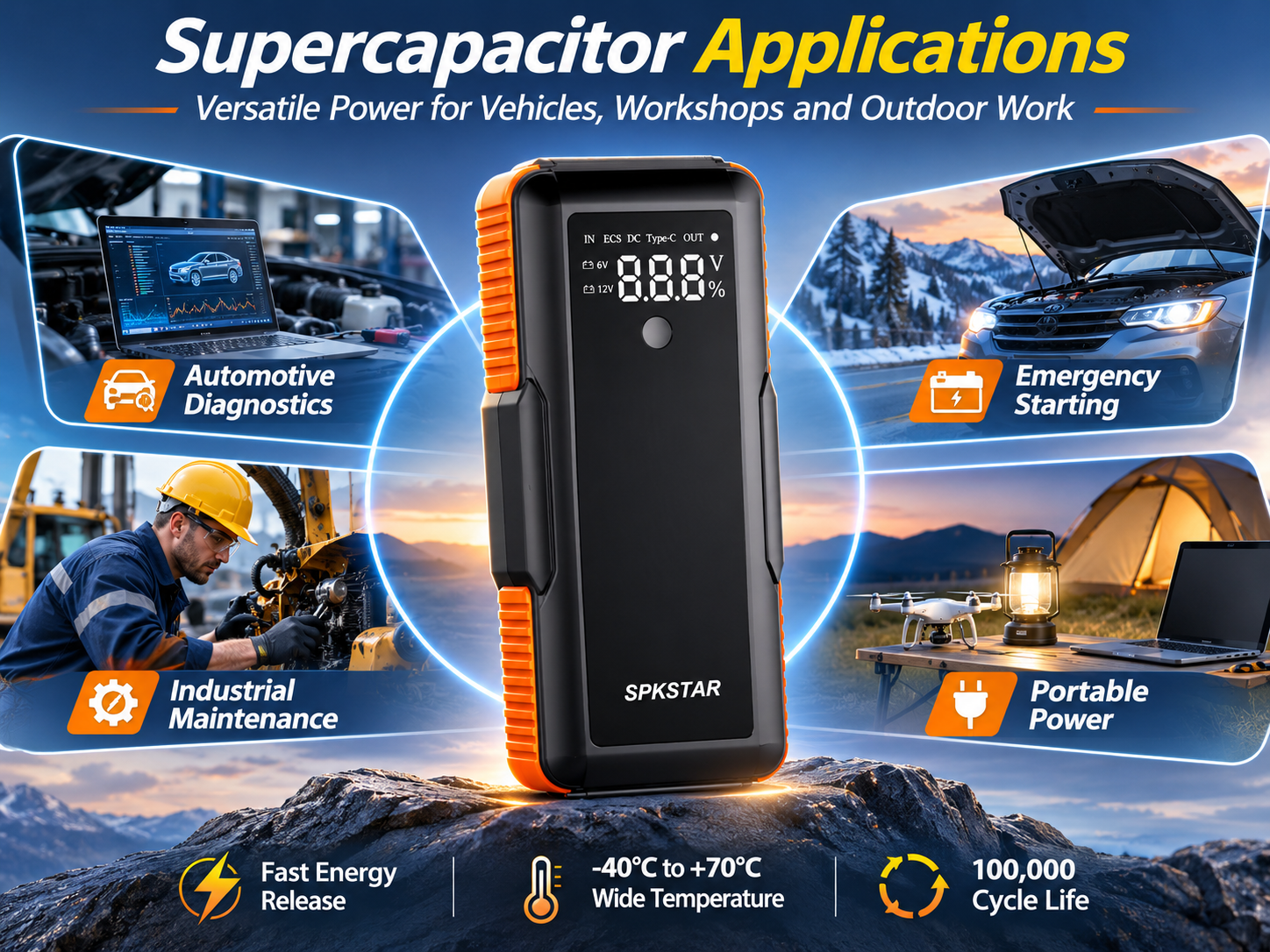
Supercapacitor jump starters may be relevant to several automotive aftermarket customer groups.
Passenger Cars and SUVs
For passenger vehicles, buyers often prioritize compact size, simple operation, and compatibility with common 12V starting systems.
Distributors can evaluate whether a supercapacitor model offers a useful alternative to conventional rechargeable jump starters for their target customers.
Professional Workshops and Roadside Assistance
Workshops and roadside service providers may need emergency starting equipment for repeated use across different vehicles.
For these customers, durability, charging methods, starting reliability, and clear operating instructions can be more important than appearance alone.
Commercial Vehicles and Fleet Maintenance
Commercial vehicle applications introduce additional requirements, including different starting voltages, larger engines, and potentially higher sustained cranking demands.
Buyers should confirm whether a product supports 12V, 24V, or both systems. Engine displacement ratings alone are not sufficient evidence of compatibility with every heavy-duty vehicle.
Cold-Climate Automotive Markets
Automotive buyers serving cold regions may be interested in products designed for wide operating temperature ranges.
However, suppliers should provide appropriate test information and clearly distinguish product operating temperature from actual cold-engine starting capability.
6. What Should Global Buyers Look for in a Supercapacitor Supplier?

As interest in new automotive emergency power technologies develops, supplier selection becomes an important part of product planning.
For brands, importers, and distributors, a reliable manufacturing partner should be able to explain the technology as well as the practical limitations of each model.
Clear and Model-Specific Technical Information
Buyers should request information about rated voltage, capacitor configuration, peak current, charging sources, vehicle compatibility, and operating temperature.
For demanding applications, measured current-versus-time and voltage-versus-time data may be more useful than peak-current claims alone.
Product Testing and Quality Management
Ask how the manufacturer evaluates electrical performance, protection functions, environmental suitability, and production consistency.
Test documentation should match the specific product configuration and intended application rather than relying only on general marketing statements.
OEM and ODM Customization Support
Private-label brands may require customized logos, packaging, accessories, instructions, or selected product features.
A supplier with engineering and manufacturing capabilities can help assess which changes are practical and how they may affect development time, cost, and product validation.
Long-Term Product Support
Product documentation, spare parts planning, after-sales communication, and consistent manufacturing support are important for distributors building long-term customer relationships.
7. SPKSTAR Supercapacitor Jump Starter Solutions
SPKSTAR develops and manufactures automotive emergency power products, including supercapacitor jump starters, multifunctional lithium battery jump starters, and portable tire inflators.
Our supercapacitor product range includes models designed for different starting-system requirements.
- SC12: A 12V supercapacitor jump starter with 1000A peak current and a 500F × 5 capacitor configuration.
- SC25: A 12V model with a 500F × 5 capacitor configuration and 1000A peak current.
- SC25 Pro: A 12V model featuring an 850F × 5 capacitor configuration and 1500A peak current.
- SC24: A dual-voltage 12V/24V supercapacitor jump starter with up to 2000A peak current at 12V and 3000A at 24V, featuring an 850F × 10 capacitor configuration.
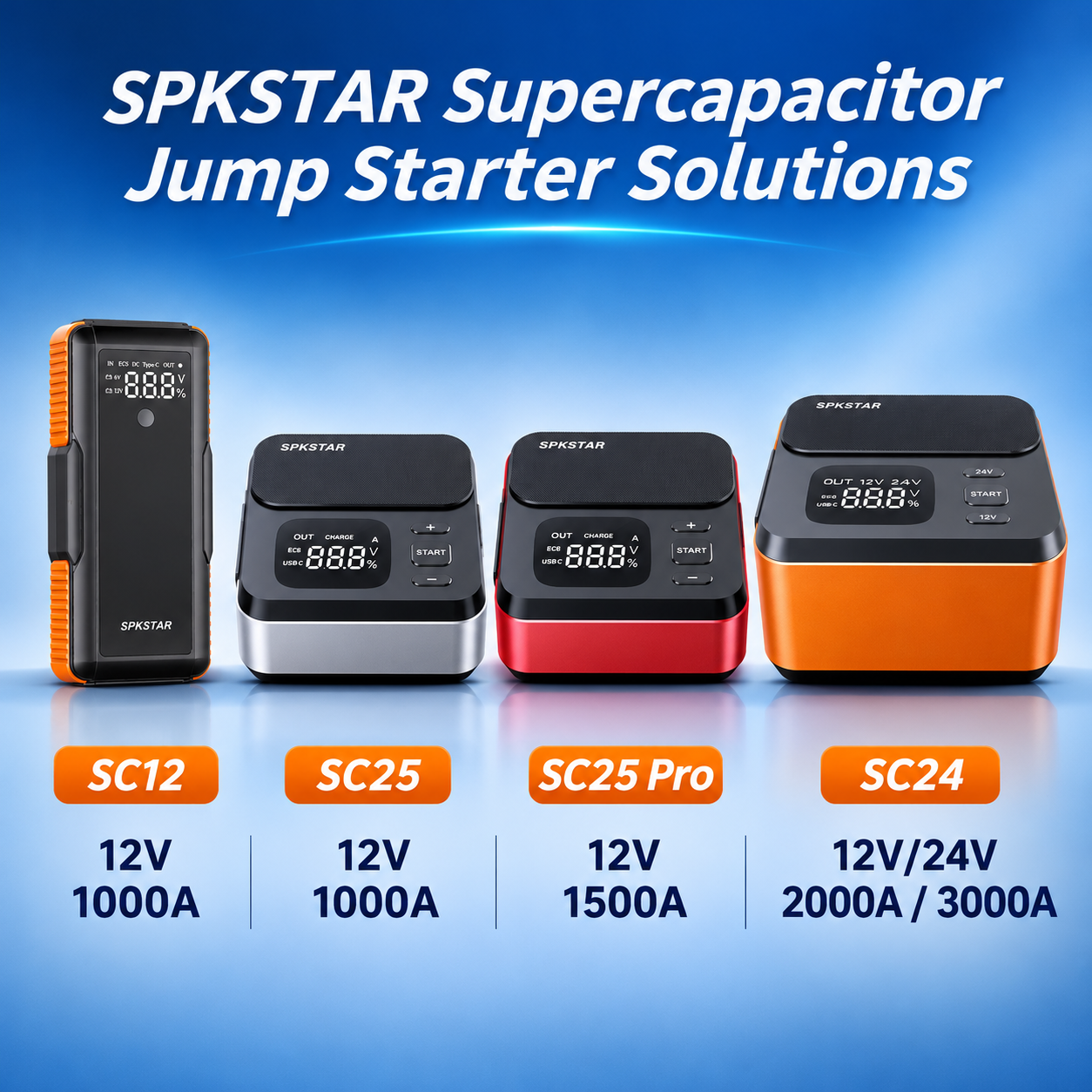
Different models are intended for different vehicle and starting requirements. Buyers should select products according to voltage, vehicle type, battery condition, and verified performance data.
In addition to standard products, SPKSTAR supports OEM/ODM cooperation for automotive brands, distributors, and other business customers. Customization options can be discussed according to project requirements and technical feasibility.
Learn more about our products and manufacturing capabilities at SPKSTAR.
8. What Do These Automotive Power Trends Mean for Distributors?

The increasing interest in supercapacitors does not mean lithium battery jump starters will disappear. Instead, the automotive emergency power market is offering buyers more technology choices.
For distributors and private-label brands, this creates several practical opportunities:
- Develop product ranges for different vehicle categories and user needs.
- Introduce supercapacitor technology as a differentiated product option.
- Educate customers about charging methods and realistic operating conditions.
- Compare technical performance rather than relying only on advertised peak current.
- Work with manufacturers that can support product development and customization.
Rather than selecting products based on technology trends alone, buyers should evaluate customer demand, intended applications, pricing, product documentation, and long-term support.
9. Frequently Asked QuestionsAre supercapacitor jump starters better than lithium jump starters?
Not in every situation. Supercapacitor models can offer advantages for certain high-power starting applications, while lithium models provide stored battery energy and often support additional functions. The better choice depends on the user’s requirements.
Can a supercapacitor jump starter start a vehicle with a completely dead battery?
It depends on the product design and available charging source. A capacitor-only unit that relies on the vehicle battery may not be able to charge if insufficient energy remains. Some models support external charging methods.
Are supercapacitor jump starters suitable for cold weather?
Some models are designed for wide operating temperature ranges. Actual cold-start performance depends on the vehicle, battery condition, charging state, and product specifications.
Can automotive brands customize supercapacitor jump starters?
Yes. Manufacturers offering OEM/ODM services may support branding, packaging, accessories, and selected product configurations, subject to technical feasibility and project requirements.
Conclusion: A More Diverse Future for Automotive Emergency Power
Supercapacitor technology is becoming an increasingly relevant option in discussions about automotive emergency power. Its high-power characteristics, cycle-life potential, and suitability for selected operating environments offer opportunities for specialized products.
At the same time, lithium battery jump starters continue to serve important customer needs, especially where stored energy and multifunctional operation are priorities.
For global automotive buyers, the key is not to choose one technology for every application. It is to understand the differences, evaluate real product performance, and build a product range that matches the needs of the market.
Looking for an OEM/ODM manufacturing partner for automotive emergency power products? Contact SPKSTAR to discuss your product requirements, target applications, and customization plans.
About Us
Founded in 2005, Shenzhen SPKSTAR Technology Co., Ltd is a leading Sino-foreign joint venture specializing in the R&D, manufacture, sales, and service of premium power solutions and automotive electronics. Our diverse product portfolio includes power supplies, car jump starters, air inflation pumps, and battery tester.
Media Contact
Company Name: Shenzhen SPKSTAR Technology Co., Ltd.
Contact Person: Media Relations
Email: Send Email
Country: China
Website: https://www.spkstarsolution.com/
Press Release Distributed by ABNewswire.com
To view the original version on ABNewswire visit: Supercapacitors Are Rapidly Gaining Ground in Automotive Power Trends


